Shopify for fashion & apparel
Shopify stores for fashion and apparel brands
Fashion stores live or die on imagery, fit and returns. We design and build Shopify stores that look like the brand, help customers choose the right size and keep returns manageable.
What makes fashion ecommerce harder than other categories?
Fit. Customers cannot try the product on, so they buy two sizes, or they hesitate and leave. Every fashion store we build is designed around three questions the shopper asks: does it look like this on a real body, which size do I take, and how easy is it to send back?
Fashion also moves fast. New collections, limited drops and seasonal sales mean the merchandising team needs to build pages themselves, without a developer for every launch.
Should each color be a separate product or a variant?
For most brands, one product per color is better for collection pages and search, while sizes stay as variants. Shopify supports up to 2,048 variants per product, so either approach is technically possible.
Separate color products let each colorway have its own photos, URL and place in collections, which is how most fashion shoppers browse. The catch is linking them together on the product page. Shopify's Combined Listings app does this natively, but it is currently available to qualified Shopify Plus merchants. On other plans we connect colorways with metafields and a custom swatch section in the theme. Our take: decide this before the product import, because changing it later means redoing URLs, redirects and reviews.
Which Shopify features solve common fashion problems?
| Fashion challenge | Shopify solution |
|---|---|
| Size and color options | Variants (up to 2,048 per product) with swatches and variant images |
| Colorways as separate products | Combined Listings (qualified Plus merchants) or metafield-linked swatches |
| Fit uncertainty | Size charts and fit notes in metafields, model height and size worn, a fit-finder app if needed |
| Returns volume | Self-serve returns in new customer accounts, with return rules and final-sale items |
| Large catalogs | Filters by size, color, fit and material through Search & Discovery |
| Drops and launches | Scheduled publishing, back-in-stock alerts and theme sections the team can reuse |
How can a fashion store reduce returns?
Better fit information before purchase, and a returns process that is quick but controlled. You will not get returns to zero, but you can avoid the ones caused by unclear sizing.
- Size charts per product type, stored in metafields so they stay consistent across hundreds of products.
- Model information on every product: height and size worn.
- Fit notes such as "runs small, size up", based on your return reasons.
- Self-serve returns: Shopify lets customers request returns from their account, with category-specific reasons like size too small or too large. Exchanges are not supported in self-serve returns, so brands that push exchanges usually add a returns app.
- Final-sale rules for sale items, set in Shopify's return rules.
What labeling rules apply to clothing sold online?
Fiber content and origin are the two that matter most.
- EU: The Textile Labelling Regulation (EU) No 1007/2011 says fiber composition must be clearly visible to the consumer before purchase, including when buying online. Put it on every product page, not only on the sewn-in label.
- US: Under the FTC's Textile and Wool Act rules, internet product descriptions must state whether an item is made in the USA, imported, or both, and fiber content must be disclosed when the ad mentions or implies a fiber.
We add a materials and care block driven by metafields, so this information is structured, consistent and easy to translate for international markets. If you sell in the EU, also check our guide to the European Accessibility Act.
What should a fashion store's design focus on?
Imagery first, then speed. Large editorial photography, on-model video and lookbooks are what make a brand feel like a brand, but heavy media slows pages down, especially on mobile.
Our portfolio includes luxury fashion retailer Anya Youngchee and footwear brand Draco Slides. In fashion the design challenge is always the same: keep the visual identity strong while the product page stays fast and easy to use. We optimize images and video loading, keep apps to the ones that earn their place and test on real phones. More on that in Shopify speed optimization.
Can a fashion brand sell wholesale on the same Shopify store?
Yes. Since April 2026, native B2B is included on Basic, Grow and Advanced, with company profiles, up to three B2B catalogs, volume pricing, quantity rules and payment terms. That covers line sheets and reorders for many boutique stockists. Brands with many wholesale price lists or deposit-based pre-season orders may need Shopify Plus.
How we build fashion and apparel stores
We start with a discovery call and design questionnaire, agree on your product structure (colorways, sizes, size charts) and collection templates, then our designer delivers a first design in under a week with up to three revision rounds. We build reusable sections so your team can launch collections and drops without us.
See our Shopify store design, Shopify development and Shopify migration services, or request a free Shopify audit.
Send us your store URL and we'll email you the fixes that matter most. No call needed.
Frequently asked questions
Is Shopify good for clothing brands?
Yes. Shopify handles large size and color ranges, filtering, self-serve returns, international selling and wholesale, and most fashion features beyond that are available as established apps. The main work is planning product structure, imagery and fit information well.
How many variants can a Shopify product have?
Up to 2,048 variants per product, after Shopify raised the limit from 100 in 2025. That is plenty for size and color combinations, although many fashion brands still split colorways into separate products for better browsing.
Does Shopify support exchanges for clothing?
Shopify's self-serve returns let customers request returns from their account, but they do not support customer-requested exchanges. Staff can create exchanges in the admin, and brands that want self-serve exchanges or store credit incentives usually add a returns app.
Do I have to show fabric composition on my website?
In the EU, yes: the Textile Labelling Regulation requires fiber composition to be clearly visible before purchase, including online. In the US, product descriptions must state country of origin, and fiber content when a fiber is mentioned or implied. Check with a legal advisor for your exact products.
What is Shopify Combined Listings?
Combined Listings is a free Shopify app that groups separate products, such as different colorways, into one product page experience with their own images and URLs. It is currently available to qualified Shopify Plus merchants. On other plans the same effect is built with metafields and custom theme sections.
Sources
- Shopify Developer Changelog: The product variant limit is now 2,048 for all merchants
- Shopify Enterprise blog: Combined Listings
- Shopify Help Center: Self-serve returns
- Shopify Help Center: Creating and processing returns and exchanges
- Shopify App Store: Search & Discovery
- Regulation (EU) No 1007/2011, Article 16 (textile fibre names and labelling)
- FTC: Threading Your Way Through the Labeling Requirements Under the Textile and Wool Acts
- Shopify Help Center: B2B
Services
How we help fashion & apparel brands.
Shopify Store Design
Custom store design in Figma: homepage, collections, product pages and everything in between, built around how your customers buy.
Shopify Development
Clean Shopify theme development: Online Store 2.0 sections, metafields, app integrations, speed work and bug fixes.
Shopify Migration
Move from WooCommerce, Wix, Squarespace, Magento or BigCommerce to Shopify with your products, customers, orders and SEO intact.
Useful guides
All articlesShopify Theme vs Custom Design: Which Is Right for Your Store?
Premium theme, customized theme or fully custom design? An honest comparison of cost, speed, flexibility and maintenance, with clear guidance on when each makes sense.
Shopify Speed Optimization: How to Make Your Store Faster in 2026
Forget chasing a PageSpeed score. Here's how to read Shopify's Web Performance dashboard, hit Core Web Vitals targets and fix the real causes of a slow store: apps, images, fonts and theme code.
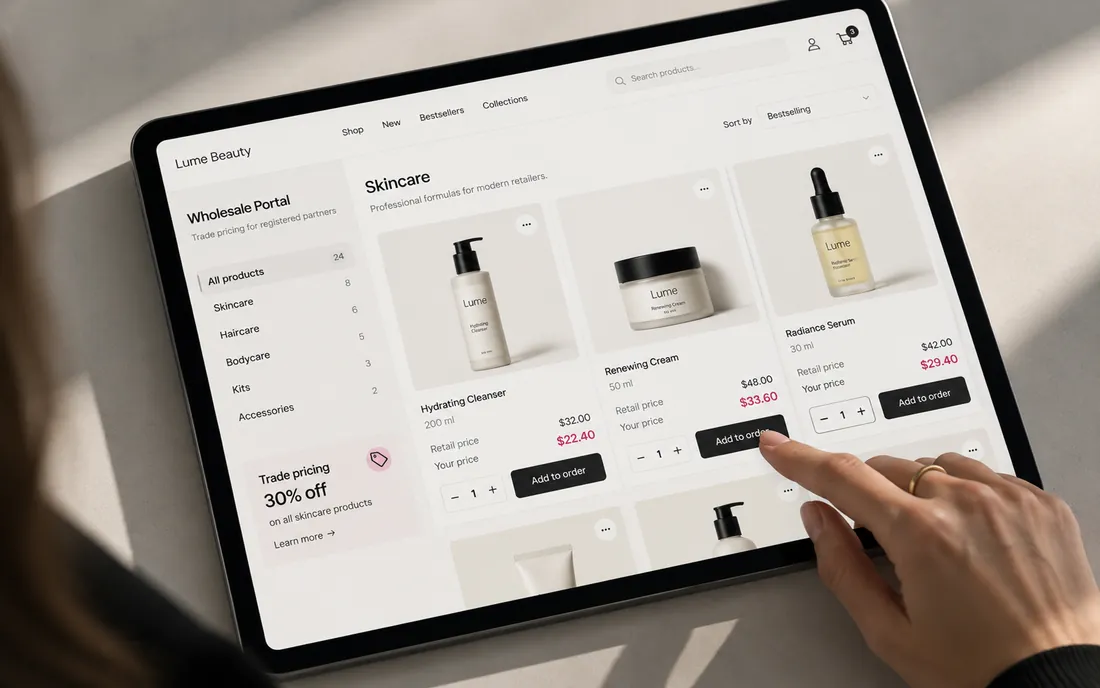 Shopify B2B without Plus
Shopify B2B Without Plus: What Basic, Grow and Advanced Can Do in 2026
Since April 2026, native B2B works on every main Shopify plan. Here's what you get without Plus, where the 3-catalog limit bites, and when an upgrade makes sense.
Let's talk
Building a Shopify store for your fashion & apparel brand?
Book a call. We'll talk through your products, customers and launch plan, then send a written proposal.