B2B & Plus
Shopify B2B Without Plus: What Basic, Grow and Advanced Can Do in 2026
Key takeaways
- On April 2, 2026, Shopify added native B2B to Basic, Grow and Advanced at no extra cost.
- The 3-catalog limit is shared across all B2B markets, and catalogs can't be assigned to individual companies.
- Deposits, partial payments, unlimited catalogs and full checkout customization are still Plus-only.
- Apps still help with registration and approval, hidden prices, VAT invoices and more than three pricing groups.
- Upgrade to Plus when you need contract pricing per account, deposits or custom checkout logic.
What changed for Shopify B2B on April 2, 2026?
On April 2, 2026, Shopify added its native B2B features to the Basic, Grow and Advanced plans at no extra cost. Before that, native B2B was Plus-only, so smaller wholesalers relied on apps, customer tags or the old Wholesale channel.
Shopify's changelog lists what non-Plus merchants now get:
- Company profiles for wholesale buyers, with locations and multiple buyers each.
- Up to 3 active B2B catalogs, assigned through Shopify Markets.
- Volume pricing and quantity rules (minimums, maximums, increments, price breaks).
- Payment terms, payment reminders, vaulted credit cards and ACH (US only).
The tools are the same ones Plus merchants use, built into the admin. If you upgrade to Plus later, you keep your setup and don't need to replatform.
What can Basic, Grow and Advanced do with B2B?
All three plans can run a real wholesale operation: company accounts, wholesale prices, minimums, case packs, net terms, PO numbers, draft-order invoices, reorders and a quick order form. Advanced also lets you show B2B buyers different storefront and checkout content.
| B2B capability | Basic | Grow | Advanced | Plus |
|---|---|---|---|---|
| Price (billed yearly / monthly) | $29 / $39 | $79 / $105 | $299 / $399 | From $2,300 (3-year term) |
| Companies, locations, buyer permissions | Yes | Yes | Yes | Yes |
| Active B2B catalogs | 3 | 3 | 3 | Unlimited |
| Catalog assigned to one company or location | No | No | No | Yes |
| Quantity rules and price breaks | Yes | Yes | Yes | Yes |
| Net terms, vaulted cards, ACH | Yes | Yes | Yes | Yes |
| Deposits, partial payments | No | No | No | Yes |
| B2B-specific storefront and checkout (Markets) | No | No | Yes | Yes |
| Staff accounts | None extra | 5 | 15 | Unlimited |
| Checkout customization | Limited | Limited | Limited | Full |
Sources: Shopify's B2B features by plan and pricing page. B2B isn't available on Starter or Retail.
What can't non-Plus plans do?
Four B2B features are still Plus-only: unlimited catalogs, assigning a catalog directly to a company or location, deposits and partial payments (along with payment requests per fulfillment). Full checkout customization, such as custom UI on the shipping and payment steps, also stays on Plus.
In practice, those gaps cause trouble for three kinds of business:
- Contract pricing. If your top 20 accounts each have negotiated prices, three shared catalogs can't hold them.
- Made-to-order or large orders. If you take 30% upfront and the rest on delivery, you need deposits and partial payments.
- Complex checkout rules. Custom fields, approval steps or account-specific checkout logic usually need Plus checkout extensibility.
How does the 3-catalog limit work?
Non-Plus stores can have 3 active B2B catalogs in total, shared across all B2B markets, not 3 per market. Catalogs are assigned to markets, not to individual companies, and the store has to use the new Shopify Markets.
So if you use all three for US retailer, US distributor and US key accounts, you have none left for a European market until you remove or draft one. Each catalog can still hold a lot of nuance: included products, a percentage adjustment, fixed prices per variant, quantity rules and quantity price breaks.
Ways to make three catalogs go further:
- Group buyers into tiers instead of pricing each account separately.
- Use price breaks for volume tiers rather than a new catalog per tier.
- Set fixed prices on the SKUs that need them, and a percentage off on the rest.
- Combine regions where currency and pricing allow it.
Our take: most small and mid-size brands with straightforward tiered wholesale pricing fit within three catalogs. Brands that negotiate prices account by account usually don't.
When do B2B apps still help?
Apps still make sense when you need something native B2B doesn't do on your plan, or doesn't do at all. That usually means more pricing groups than three catalogs allow, or workflow features around registration and approval.
These are the gaps merchants raise most in the Shopify Community and on Reddit:
- Wholesale registration and approval. Application forms that collect a tax or VAT ID and let you approve buyers before they see prices.
- Hiding prices or add-to-cart from logged-out visitors.
- Tag-based or customer-specific pricing beyond 3 catalogs, without moving to Plus.
- VAT display and invoices (prices with and without VAT, compliant PDF invoices), which matter most for EU wholesale.
- ERP sync for orders, inventory, customers and invoices.
One warning: if a native catalog discount and an app's discount both apply to the same buyer, prices can overlap or conflict at checkout. Choose one pricing source per buyer group and test real orders before you launch.
Should I move to Shopify Plus for B2B?
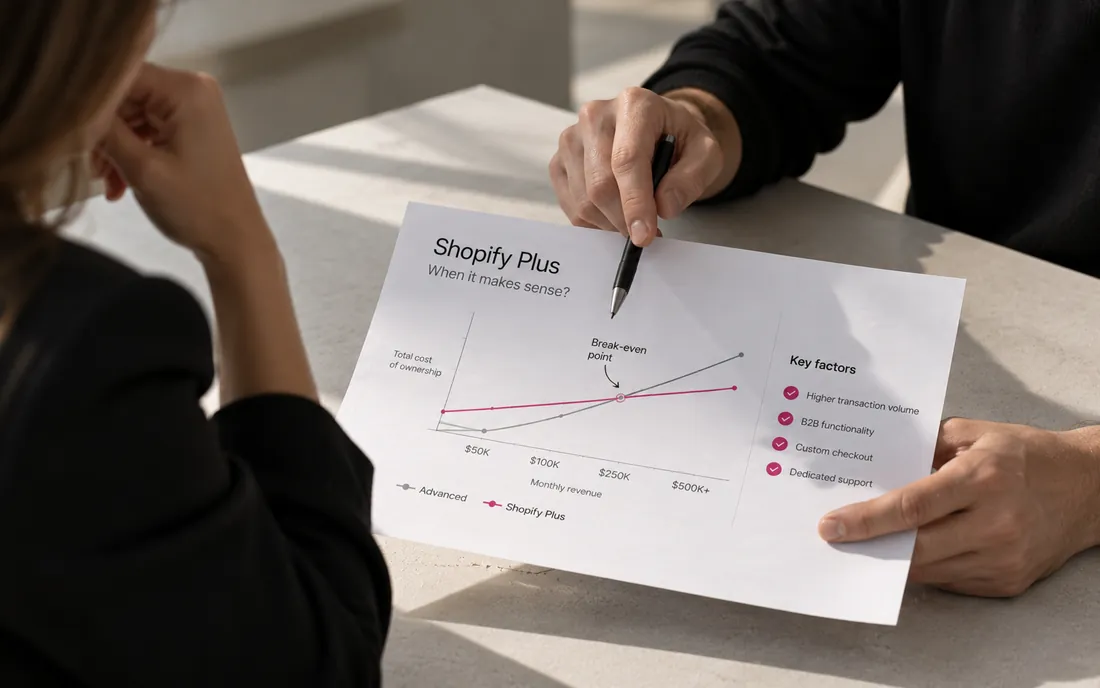
Move to Plus when its B2B-only features would save more time or win more revenue than the roughly $2,000 a month it costs over Advanced. Usually that means you need customer-specific price lists, deposits or partial payments, or checkout rules you can't build otherwise.
Upgrade signals:
- You need more than 3 catalogs, or one catalog per key account.
- Your terms involve deposits, split payments or invoicing per shipment.
- You want a separate gated wholesale site without paying for a second plan (Plus includes up to 9 expansion stores).
- Your team needs more than 15 staff accounts.
- Your checkout needs custom fields, validation or B2B-specific steps.
Stay on Advanced (or Grow) if your wholesale is tiered, your buyers pay by card or standard net terms, and an app or two covers registration. We go through the cost math in Is Shopify Plus worth it? and compare the plans in Shopify Plus vs Advanced.
How do I set up B2B on a non-Plus plan?
- Switch to the current customer accounts. Legacy accounts can't be used for B2B.
- Make sure the store uses the new Shopify Markets, which non-Plus B2B catalogs need.
- Create companies and locations, or import them from your current wholesale customers.
- Plan your pricing in three tiers, then build up to 3 catalogs with quantity rules and price breaks.
- Assign catalogs to your B2B market and set payment terms per location.
- Add any apps you need for registration or price hiding, then test full orders as a buyer.
For the full feature set, see our complete Shopify B2B guide.
How we can help
We set up B2B on all Shopify plans, including pricing structures that make the most of three catalogs and storefronts built for wholesale buyers. If you're not sure your model fits without Plus, our Shopify B2B services page explains how we work.
Send us your store URL and we'll email you the fixes that matter most. No call needed.
Frequently asked questions
Is Shopify B2B free on the Basic plan?
Yes. Shopify includes native B2B on Basic, Grow and Advanced at no extra charge, so you only pay your plan fee. Apps you add for registration, pricing or ERP sync are billed separately.
Is the 3-catalog limit per market?
No. The limit is 3 active B2B catalogs across all your B2B markets combined. If you need regional and tier-based pricing together, you'll run out quickly.
Can I give one customer their own prices without Plus?
Not with native catalogs alone, because non-Plus catalogs are assigned to markets, not to individual companies. You can use one of your three catalogs for a key-account tier, or use a wholesale pricing app for customer-specific prices.
What happens to my B2B setup if I upgrade to Plus later?
It carries over. Companies, catalogs, terms and rules are the same native features on every plan, so moving to Plus unlocks extra capabilities without replatforming.
Can I hide prices from non-wholesale visitors?
Native B2B shows catalog prices to logged-in B2B buyers and retail prices to everyone else. It doesn't gate a blended store. To hide prices or block access for logged-out visitors, you'll need theme work or an app, or a dedicated B2B store.
Sources
- Shopify Changelog: Key B2B features now available on non-Plus plans
- Shopify News: B2B for all
- Shopify Help Center: Shopify B2B features by plan
- Shopify Help Center: Requirements and considerations for using B2B
- Shopify Help Center: Choosing a store type for B2B
- Shopify Pricing
- Shopify Help Center: Shopify Plus plan
- Shopify Community: How to set up B2B selling without using Shopify Plus?
- Wholesale Helper: The 3-catalogue limit of Shopify B2B