Shopify studio for Singapore
Shopify design and development for brands in Singapore
We design and build Shopify stores for Singaporean brands and for brands using Singapore as their base for Southeast Asia, working remotely by email and Basecamp.
What do Singaporean shoppers expect from an online store?
Singaporean shoppers expect a fast mobile checkout, the wallets and bank transfers they already use, prices shown in Singapore dollars with GST included, and quick, trackable delivery. A store built only for cards and US-style shipping will feel imported.
Singapore is also a launchpad. Many brands start here and then sell into Malaysia, Indonesia, Thailand, the Philippines and Vietnam, so the store should be built for more than one market from day one.
Which payment methods can a Singapore Shopify store offer?
Shopify Payments is available to businesses in Singapore and covers cards, Apple Pay, Google Pay and Shop Pay. PayNow and most buy now, pay later options are not part of Shopify Payments, so they come from third-party payment providers.
With Shopify Payments, Singapore stores accept Visa, Mastercard, American Express and UnionPay, plus accelerated checkouts. GrabPay is listed as a Shopify Payments local method for customers in Singapore paying in SGD, but it is in early access, so it may not appear in your admin yet.
For PayNow, the QR bank transfer most Singaporeans use daily, you need a separate provider. Local gateways such as HitPay list PayNow, GrabPay, ShopeePay and BNPL options on a single Shopify connection. BNPL brands such as Atome also offer their own Shopify apps. Our take: run Shopify Payments for cards and wallets, and add one well-supported local gateway for PayNow rather than stacking several. Check whether Shopify's third-party transaction fee applies on your plan.
How do GST and the Overseas Vendor Registration regime work?
Singapore GST is 9%. Local businesses must register once taxable turnover exceeds S$1 million in 12 months, and GST-registered businesses must show GST-inclusive prices, including on their website.
If you sell into Singapore from abroad, the Overseas Vendor Registration (OVR) regime has applied to imported low-value goods since January 1, 2023. Low-value goods are non-dutiable items valued at S$400 or less and shipped into Singapore by air or post. An overseas seller must register and charge GST at checkout if its global turnover exceeds S$1 million and its B2C sales of low-value goods and remote services to Singapore exceed S$100,000.
On Shopify, we set GST in your tax settings and show GST-inclusive prices if you are registered. Your accountant confirms registration status; we make the store reflect it.
| Topic | What applies in Singapore | How we handle it on Shopify |
|---|---|---|
| Cards and wallets | Visa, Mastercard, Amex, UnionPay, Apple Pay, Google Pay | Shopify Payments with accelerated checkout |
| PayNow | Not part of Shopify Payments | Third-party gateway from the Shopify App Store |
| GrabPay | Shopify Payments local method, early access | Enable when available, or via a local gateway |
| Buy now, pay later | Offered by third-party providers such as Atome | Provider app or gateway, tested at checkout |
| GST | 9%; registration above S$1 million taxable turnover | Tax settings and GST-inclusive price display |
| Imported low-value goods | OVR: S$400 or less by air or post | GST collected at checkout for registered overseas sellers |
| Personal data | PDPA consent, notice and DPO rules | Consent-aware forms, privacy policy, cookie banner |
How does shipping work for a Singapore Shopify store?
Shopify's discounted Shopify Shipping labels are not offered in Singapore, so delivery runs through carrier apps or a third-party logistics provider.
Singapore Post, Ninja Van and courier services are common choices, and Ninja Van publishes its own Shopify app for creating delivery orders and printing airway bills from the admin. Because the island is small, shoppers are used to quick local delivery, so clear cut-off times, delivery estimates on the product page and tracking emails matter.
How do you sell across Southeast Asia with Shopify Markets?
Shopify Markets lets one store serve several countries, each with its own currency, language, domain or subfolder, and price list. That suits a Singapore brand expanding into the region without running separate stores.
- Currencies. Show MYR, IDR, THB, PHP or VND with automatic conversion and rounding, or set fixed local prices per market.
- Languages. Add translations such as Simplified Chinese, Malay, Thai, Vietnamese or Indonesian, assigned to the markets that need them.
- Domains. Use subfolders like /en-my/ or separate country domains so search engines index each market.
- Catalogs. Hide products you can't ship or sell in a given country.
Payment methods and import tax rules differ by country, so we plan each market's checkout separately. Our guide to Shopify Markets covers the setup.
What does the PDPA mean for your store?
The Personal Data Protection Act requires consent and a clear purpose before you collect personal data, a designated Data Protection Officer with public contact details, and notification to the PDPC within 3 calendar days of assessing a breach as notifiable.
In practice: newsletter and SMS opt-ins that are clearly worded, a privacy policy naming your DPO contact, and care with SMS or call marketing to Singapore numbers registered on the Do Not Call Registry. Your legal advisor owns the wording; we build the forms and consent flows so they match it.
How do we work with brands in Singapore?
We're a remote-first studio with a presence in Barcelona and no office in Singapore; we work with Singaporean brands remotely. We work asynchronously by email and Basecamp and schedule calls within your working hours.
- Discovery call. Book a slot at silverarc.youcanbook.me.
- Written proposal with scope and timeline.
- Design questionnaire, then a first Figma design in under a week, with up to 3 revision rounds.
- Development in your own Shopify account: payments, GST settings, shipping apps and markets.
- Launch and handover. You own the store, theme, domain and data.
Shopify services for Singapore brands
- Shopify store design: a custom Figma design built mobile-first.
- Shopify development: theme builds, payment and shipping integrations, multi-market setup.
- Shopify migration from WooCommerce, Magento or other platforms.
- Shopify B2B for distributors and wholesale buyers across the region.
- Shopify SEO and CRO for regional search and checkout conversion.
Ready to talk about your store? Get in touch.
Frequently asked questions
Do you have an office in Singapore?
No. We're a remote-first studio with a presence in Barcelona, and we don't have an office or staff in Singapore. We work with Singaporean brands remotely, asynchronously by email and Basecamp, and schedule calls within your working hours.
Can I accept PayNow on Shopify?
Yes, but not through Shopify Payments. PayNow is added with a third-party payment provider from the Shopify App Store, such as a local gateway that supports PayNow QR payments. Shopify may charge a third-party transaction fee depending on your plan, so it's worth comparing before you choose.
Is Shopify Payments available in Singapore?
Yes. Businesses in Singapore can use Shopify Payments for Visa, Mastercard, American Express and UnionPay cards, plus Apple Pay, Google Pay and Shop Pay. GrabPay is listed as a local method for Singapore customers paying in SGD, but it is in early access and not available to every store yet.
Do I need to charge GST on my Shopify store?
If you are a Singapore business, GST registration is compulsory once taxable turnover exceeds S$1 million in 12 months, and registered businesses must display GST-inclusive prices. Overseas sellers of low-value goods to Singapore consumers may need to register under the OVR regime. Your accountant confirms your status; we configure Shopify to match.
Can one Shopify store sell to Malaysia, Indonesia and Thailand too?
Yes. Shopify Markets lets one store present local currencies, translated content, market-specific domains or subfolders and separate price lists. Payment methods and import taxes differ by country, so each market needs its own checkout and duties plan.
Sources
- Shopify Help Center: Shopify Payments for Singapore
- Shopify Help Center: Payment methods for Shopify Payments in Singapore
- Shopify Help Center: GrabPay
- Shopify Help Center: Local payment methods
- HitPay: Shopify payment gateway for Singapore
- Shopify App Store: Atome Buy Now Pay Later
- IRAS: GST e-Tax Guide, Taxing imported low-value goods by way of the OVR regime
- Singapore Customs: Overseas Vendor Registration Regime
- ASEAN Briefing: GST in Singapore, when overseas vendors must register
- Sufio: GST guide for Shopify stores in Singapore
- IRAS: Displaying and quoting prices
- Forvis Mazars: Singapore's GST price display requirements
- Shopify Help Center: Shipping carriers by location
- Shopify App Store: Ninja Van
- Shopify.dev: About Shopify Markets
- PDPC: Personal Data Protection Act overview
- PDPC: Reporting a data breach
- CMS Expert Guide: Data protection and cyber security laws in Singapore
Services
What we do for brands in Singapore.
Shopify Store Design
Custom store design in Figma: homepage, collections, product pages and everything in between, built around how your customers buy.
Shopify Development
Clean Shopify theme development: Online Store 2.0 sections, metafields, app integrations, speed work and bug fixes.
Shopify Migration
Move from WooCommerce, Wix, Squarespace, Magento or BigCommerce to Shopify with your products, customers, orders and SEO intact.
Shopify B2B & Wholesale
Native Shopify B2B: company accounts, wholesale catalogs, volume pricing, payment terms and a buyer portal, on one store with your DTC site.
Shopify Plus Development
Shopify Plus builds and upgrades: checkout extensibility, Shopify Functions, Flow automations, expansion stores and advanced B2B.
Shopify SEO & CRO
Shopify SEO as a one-time setup, an ongoing monthly plan, or a roadmap your team carries out, plus AI-search readiness and conversion fixes.
Shopify Maintenance & Support
A monthly Shopify support plan: a developer on hand for fixes, updates, new sections, app changes and speed checks, without hiring in-house.
Shopify Redesign
A full redesign of your existing Shopify store, designed in Figma and built on a duplicate theme, keeping your products, URLs and rankings intact.
Branding & Logo Design
Logo design, visual identity and brand books for new and growing brands, ready to use on your website, Shopify store, packaging and social.
Website Design (non-Shopify)
Brand, portfolio and marketing websites designed in Figma and built on Framer, for businesses that don't need a store.
Useful guides
All articlesShopify Markets: How to Sell Internationally From One Store
How to set up Shopify Markets for currencies, languages, subfolders, duties and local payment methods, plus the EU VAT, UK and US tax rules international sellers keep asking about.
 How much does a Shopify store cost
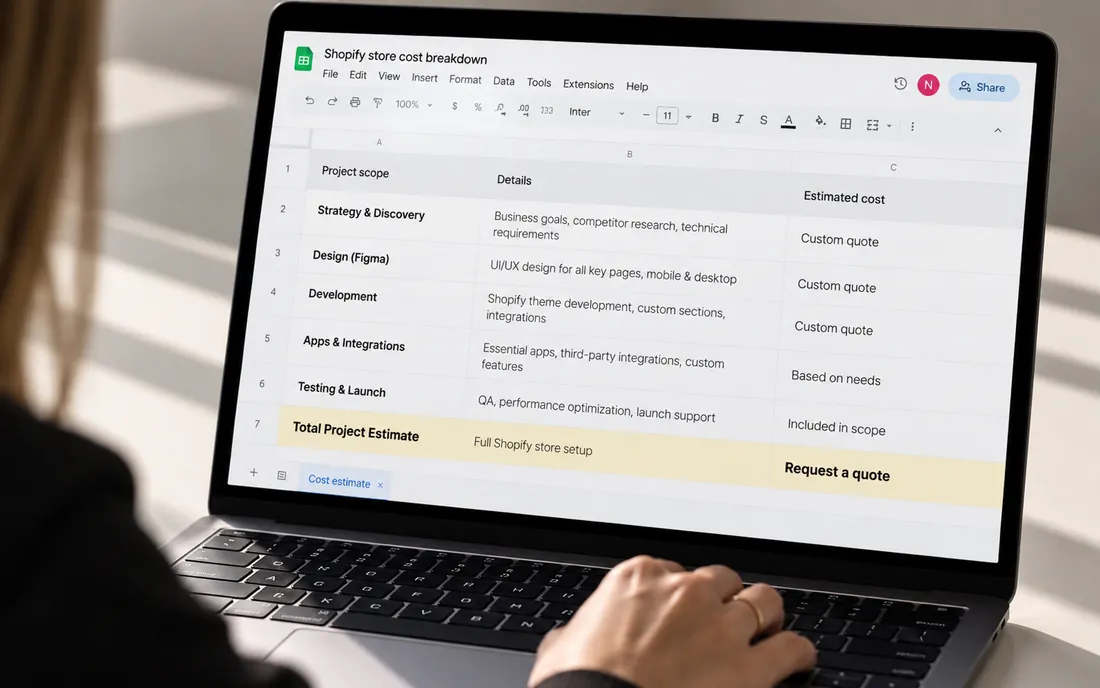
How Much Does a Shopify Store Cost in 2026?
A full breakdown of what a Shopify store really costs in 2026, from the monthly plan and payment fees to themes, apps and professional design and development.
How to Hire a Shopify Developer (Without Regretting It)
Freelancer, studio or agency? Where to find good Shopify developers, the questions that separate pros from pretenders, and how to give access without losing control of your store.
Let's talk
Building a Shopify store for Singapore?
Book a call. We'll talk through your market, payments and launch plan, then send a written proposal.