Shopify for beauty & skincare
Shopify stores for beauty and skincare brands
Beauty customers buy on ingredients, results and routine, then reorder. We design and build Shopify stores that explain the formula, sell the regimen and make replenishment effortless.
What does a beauty brand need from its Shopify store?
Three things: a product page that explains why the formula works, a way to sell a routine instead of a single item, and easy reorders. Skincare and haircare run out, so the store has to be built around the second and third purchase, not only the first.
Beauty is also a crowded category on social media. Your store is where an ad click or creator mention turns into trust, so it has to answer "is this for my skin or hair type?" within seconds.
Which Shopify features matter most for beauty and skincare?
Subscriptions, structured product data, bundles and reviews do most of the work. Here is how we usually map them:
| Beauty challenge | Shopify solution |
|---|---|
| Replenishment and repeat orders | Shopify Subscriptions (free, by Shopify) with skip, pause and self-service in customer accounts |
| Ingredient lists, skin type, how to use | Metafields for INCI list, key actives, skin or hair type, connected to theme sections |
| Selling a routine | Bundles or a routine builder, plus complementary product recommendations |
| Shade, scent or size options | Variants with swatches and variant images |
| Social proof | A reputable reviews app with photo reviews and review snippets |
| Finding the right product | Filters by concern and type through Search & Discovery, or a product quiz |
Shopify Subscriptions supports weekly, monthly or yearly plans, subscription discounts, and lets customers skip, pause or cancel from their account. For many brands it is enough to start; dedicated subscription apps add things like build-a-box and advanced retention flows if you need them later.
How should ingredients and claims be shown on a beauty product page?
Show the full ingredient list, highlight the key actives in plain language, and make every claim one you can back up. Claims are regulated in both the EU and the US.
- EU: The Cosmetics Regulation (EC) No 1223/2009 requires a responsible person in the EU, a product safety report and notification in the CPNP portal before a product is sold. Claims must meet the common criteria in Regulation (EU) No 655/2013, which include truthfulness and evidential support.
- US: The Modernization of Cosmetics Regulation Act (MoCRA) requires facility registration, product listing with ingredients, safety substantiation records and reporting of serious adverse events to the FDA within 15 business days.
- Drug claims: Wording like "treats acne" or "repairs skin barrier damage" can move a product into drug territory in many markets. Keep marketing copy and product pages aligned with what your regulatory advisor has approved.
On Shopify, we store ingredients and approved claims in metafields, so the same wording appears everywhere and can be updated in one place when a formula changes. That also makes it easier for search engines and AI assistants to read your products correctly.
What design priorities convert best for beauty stores?
Texture, results and reassurance. We focus on:
- Texture and application media: swatches, short video of the product on skin or hair.
- A "why it works" block: key ingredients, what they do, who the product is for.
- Routine sections: "use with" products and step-by-step order of application.
- Subscription offer next to the price, with clear terms and how to cancel.
- Reviews filtered by skin or hair type, where the reviews app supports it.
Our portfolio includes KIN Cosmetics, a premium Australian haircare brand. In this category the store has to feel as considered as the packaging, or a premium price feels unjustified.
Can beauty brands sell internationally and wholesale on the same store?
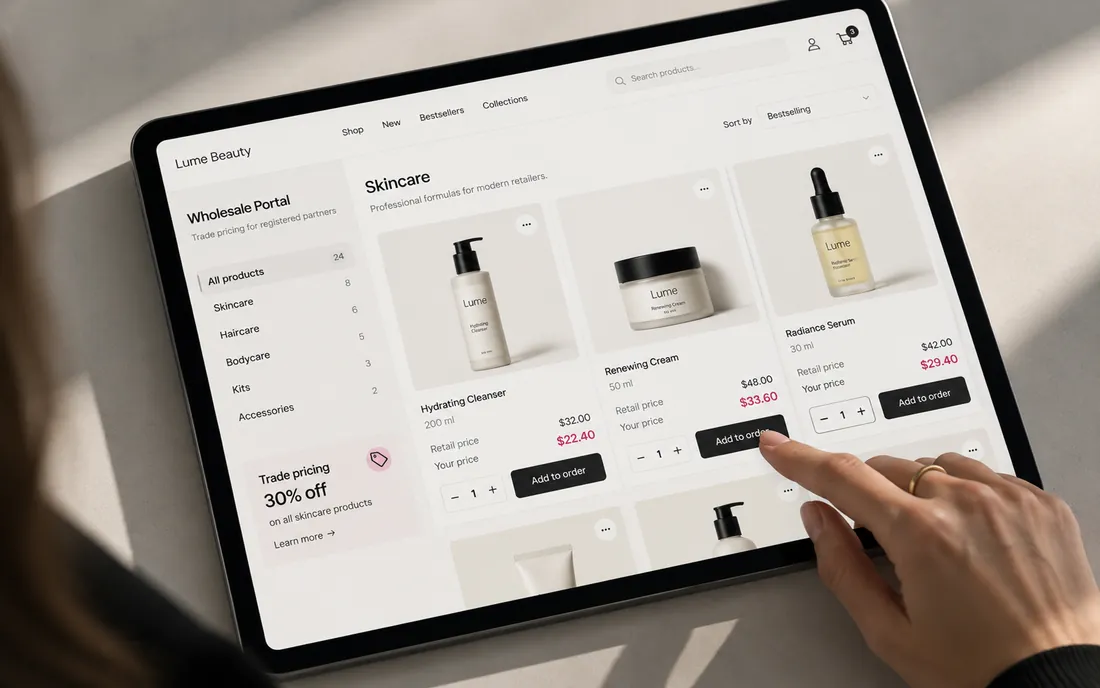
Yes. Shopify Markets handles local currencies, languages and domains, and since April 2026 native B2B is available on the Basic, Grow and Advanced plans, so you can sell to salons, spas and stockists with their own price lists and payment terms. Check each market's cosmetics rules before shipping there. See our guides to selling internationally and Shopify B2B without Plus.
Should we migrate an existing beauty store to Shopify?
If you are on WooCommerce, Wix or Squarespace and struggling with subscriptions or speed, usually yes. The critical part is moving active subscriptions, customer accounts and reviews without breaking reorders, plus redirecting old URLs to protect search traffic. Read our migration SEO checklist before you start.
How we build beauty and skincare stores
We start with a discovery call and design questionnaire, plan your product data (ingredients, concerns, routines) and subscription model, then our designer delivers a first design in under a week with up to three revision rounds. Development happens in your own Shopify account, so you own everything.
See our Shopify store design, Shopify development and SEO and CRO services, or get a free Shopify audit of your current store.
Send us your store URL and we'll email you the fixes that matter most. No call needed.
Frequently asked questions
Is Shopify good for skincare brands?
Yes. Shopify covers the features skincare brands rely on most: subscriptions, bundles, reviews, international selling and fast mobile checkout. Shopify's own Subscriptions app is free, and the App Store has established options for reviews, quizzes and loyalty.
What is the best way to sell subscriptions on a beauty store?
Start with Shopify Subscriptions if you need standard replenishment plans with discounts, skip, pause and self-service. Move to a dedicated subscription app if you need build-a-box, advanced retention offers or complex bundles. Either way, show the subscription option next to the price with clear terms.
Do I need to show the full ingredient list on my website?
Shoppers and retailers expect it, and it reduces support questions and returns. EU and US rules regulate the label and claims, so keep the website list identical to the approved label. Storing it in a metafield keeps it consistent across product pages, feeds and marketplaces.
What claims can I make about my skincare products?
In the EU, claims must meet the common criteria of Regulation 655/2013, including truthfulness and evidential support. In the US, cosmetic claims must not suggest the product treats or prevents disease, or it may be regulated as a drug. Have your regulatory advisor approve claims before they go on product pages and ads.
Can I sell to salons and stockists on the same Shopify store?
Yes. Since April 2026 native B2B is available on Basic, Grow and Advanced, with company profiles, B2B catalogs, volume pricing, quantity rules and payment terms. Shopify Plus adds unlimited catalogs and more checkout customization.
Services
How we help beauty & skincare brands.
Shopify Store Design
Custom store design in Figma: homepage, collections, product pages and everything in between, built around how your customers buy.
Shopify Development
Clean Shopify theme development: Online Store 2.0 sections, metafields, app integrations, speed work and bug fixes.
Shopify SEO & CRO
Shopify SEO as a one-time setup, an ongoing monthly plan, or a roadmap your team carries out, plus AI-search readiness and conversion fixes.
Useful guides
All articlesShopify Markets: How to Sell Internationally From One Store
How to set up Shopify Markets for currencies, languages, subfolders, duties and local payment methods, plus the EU VAT, UK and US tax rules international sellers keep asking about.
 Shopify B2B without Plus
Shopify B2B Without Plus: What Basic, Grow and Advanced Can Do in 2026
Since April 2026, native B2B works on every main Shopify plan. Here's what you get without Plus, where the 3-catalog limit bites, and when an upgrade makes sense.
Shopify Migration SEO Checklist: Pre-Launch, Launch and Post-Launch
The step-by-step SEO checklist we use when moving stores to Shopify: what to capture before launch, what to do on launch day, and what to monitor for the weeks after.
Let's talk
Building a Shopify store for your beauty & skincare brand?
Book a call. We'll talk through your products, customers and launch plan, then send a written proposal.