Shopify for wholesale & manufacturers
Shopify B2B stores for wholesalers and manufacturers
We design and build wholesale portals on Shopify that replace PDF price lists and emailed orders with company accounts, trade pricing and one-page reordering.
What do wholesale buyers need from a Shopify store?
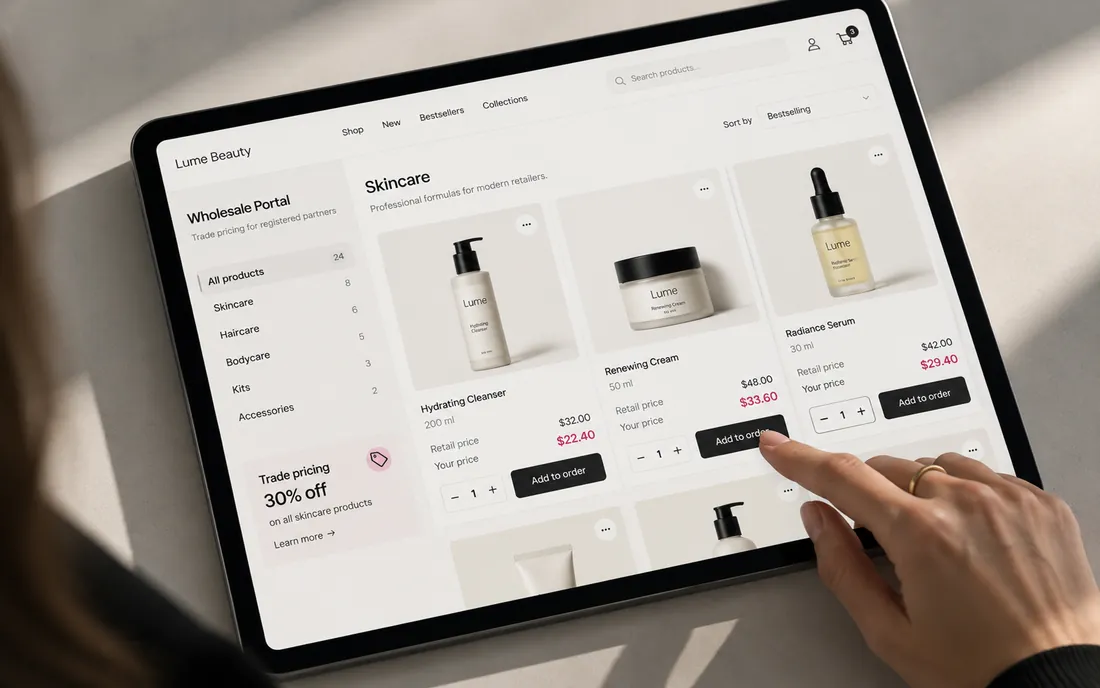
Wholesale buyers want to see their own price, order in the right pack sizes and reorder in minutes. They aren't browsing; they're restocking.
Many manufacturers we talk to still run wholesale on PDF price lists, spreadsheets and emailed orders that someone retypes into an ERP. Every one of those steps is a chance for a wrong price or a missed line. A good B2B store moves that work to the buyer: they log in, see their catalog, hit the minimums and check out on terms.
The details that matter most for trade buyers:
- Prices, minimums and case packs that match their agreement
- Search by SKU or product code, not only by browsing
- A quick order list to enter quantities for many variants at once
- Order history and one-click reorders
- Spec sheets, certificates and lead times on the product page
- Net terms, PO numbers and invoices instead of card-only checkout
Do manufacturers still need Shopify Plus for B2B?
Usually not. Since April 2, 2026, the core B2B features are part of Basic, Grow and Advanced at no extra cost, so Plus is now about scale and contract pricing, not access.
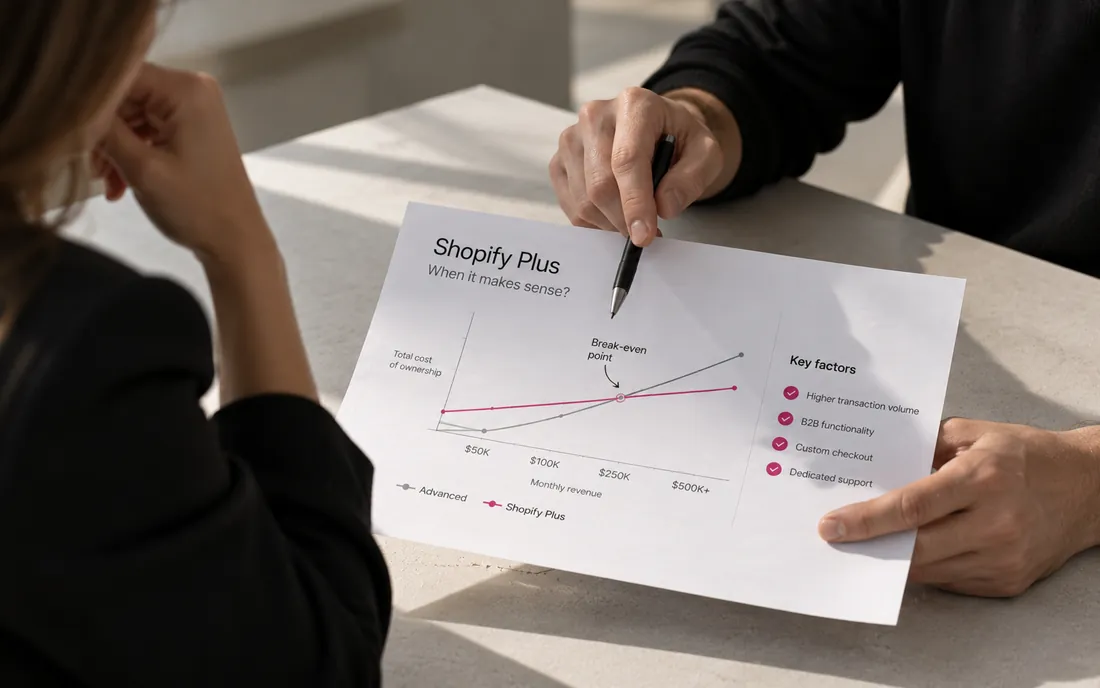
Every plan from Basic up gets companies and company locations, up to 3 B2B catalogs assigned through Markets, quantity rules, price breaks, net payment terms, vaulted cards and the quick order list. Shopify Plus (from $2,300 a month on a 3-year term) adds unlimited catalogs, catalogs assigned directly to a single company or location, deposits, partial payments and full checkout customization.
Our take: if your pricing comes down to a few tiers, such as retailer, distributor and export, three catalogs plus price breaks go a long way. If every large account has its own negotiated price list, that points to Plus. Our Shopify B2B guide has the full feature table, and Shopify B2B without Plus covers the non-Plus side.
Which Shopify features solve common wholesale problems?
Most wholesale requirements map to a native feature. The gaps are usually ERP sync and very customer-specific pricing.
| Wholesale challenge | Shopify solution | Plan |
|---|---|---|
| Different prices for retailers and distributors | B2B catalogs with percentage or fixed prices | Up to 3 on Basic to Advanced; unlimited on Plus |
| One contract price list per key account | Catalog assigned directly to a company or location | Plus |
| Minimum order quantities and case packs | Quantity rules (minimum, maximum, increment) | All B2B plans |
| Tiered pricing for bigger orders | Quantity price breaks | All B2B plans |
| Net 30 or Net 60 accounts | Payment terms with reminders, vaulted cards, ACH in the US | All B2B plans |
| Upfront deposit on large production orders | Deposits and partial payments | Plus |
| Fast restocking | Quick order list, reorders, PO numbers, draft orders | All B2B plans |
| Approval of large or unusual orders | Shopify Flow workflows using B2B objects | All B2B plans |
Sources: Shopify's B2B features by plan and the April 2026 changelog.
Should wholesale and retail share one store?
If you sell the same products to both audiences, one blended store is usually simpler and cheaper. A separate wholesale store makes sense when you need a fully gated site, separate inventory or different branding.
In a blended store, logged-in buyers tied to a company location see their catalog prices and everyone else sees retail. You can't lock the whole store to B2B buyers, but the theme can hide prices or trade-only sections from guests. On Advanced and Plus, Markets lets you show different storefront content to B2B and DTC customers. Shopify warns that switching store types later means redoing companies, catalogs and storefront setup, so we settle this in discovery.
How does a B2B store connect to an ERP and product data?
Through a connector app or a custom integration on Shopify's APIs. Budget for it separately, because connectors often cost more than the Shopify plan.
Manufacturers tend to have product data spread across an ERP, a PIM or a shared drive. We map it into Shopify products, variants and metafields, so technical specs, materials, certifications and downloadable data sheets show up consistently on every product page. Shopify Flow handles lighter automation, such as tagging new companies, alerting a sales rep about large orders or holding orders above a credit limit.
A few limits to plan around: B2B orders and draft orders cap at 500 line items, accelerated checkouts like Shop Pay don't work for B2B, and subscriptions aren't supported on B2B orders. Some third-party apps aren't B2B compatible, so we check each one before recommending it.
What design and UX matter most for a wholesale portal?
Speed and clarity beat visual flourish. A buyer placing a 60-line restock order needs dense, scannable pages that work on a laptop and a phone on the warehouse floor.
We prioritize SKU search, list-style collection pages with quantity inputs, clear minimums next to the add-to-cart button, visible pack sizes and lead times, and an account area where buyers switch between their company locations. Shopify's free Trade theme is a solid B2B starting point; for brands that also sell retail, we usually design one theme that serves both audiences.
Wholesale terms belong on the site too: who can apply, minimum opening orders, payment terms and returns for trade accounts. A simple application form that creates a company for review saves your team a lot of back-and-forth.
How we build wholesale and manufacturer stores
We've worked with 400+ companies since 2017, including wholesale manufacturers and factories moving trade orders online. We start with how you price and sell today, choose blended or dedicated and the right plan, then design the buyer experience in Figma before building catalogs, companies and integrations. See our Shopify B2B services, Shopify Plus work and migrations to Shopify, or request a free Shopify audit of your current setup. Selling to interior designers or retailers? See our pages on furniture and home decor and wallpaper.
Send us your store URL and we'll email you the fixes that matter most. No call needed.
Frequently asked questions
Can I run wholesale on Shopify Basic?
Yes. Since April 2, 2026, Basic, Grow and Advanced include native B2B: companies, up to 3 catalogs, quantity rules, price breaks and net payment terms. B2B isn't available on the Starter or Retail plans.
Can each wholesale customer have their own price list?
On Plus, yes: catalogs can be assigned directly to a company or a single company location, and there's no catalog limit. On Basic to Advanced you get up to 3 catalogs assigned through B2B markets, which suits tiered pricing better than one price list per account.
Can wholesale buyers pay on net terms?
Yes. You can set terms such as Net 30 or due on fulfillment for each company location, and Shopify sends payment reminders. Buyers can also pay by card, vaulted card or ACH in the US. Deposits and partial payments need Plus.
Can I hide wholesale prices from the public?
B2B prices only show to logged-in buyers tied to a company location; everyone else sees retail prices. If you don't sell retail at all, a dedicated B2B store or theme logic that hides prices and products from guests keeps the catalog private.
Do you replace our ERP?
No. Shopify becomes the ordering front end, and your ERP stays the system of record for stock, pricing and invoicing. We connect the two through a connector app or a custom integration and agree up front which system owns which data.
Sources
- Shopify Changelog: Key B2B features now available on non-Plus plans (April 2, 2026)
- Shopify News: B2B for all
- Shopify Help Center: Shopify B2B features by plan
- Shopify Help Center: Requirements and considerations for using B2B
- Shopify Help Center: Choosing a store type for your B2B business
- Shopify Help Center: Shopify Flow
- Shopify Pricing
Services
How we help wholesale & manufacturers brands.
Shopify B2B & Wholesale
Native Shopify B2B: company accounts, wholesale catalogs, volume pricing, payment terms and a buyer portal, on one store with your DTC site.
Shopify Plus Development
Shopify Plus builds and upgrades: checkout extensibility, Shopify Functions, Flow automations, expansion stores and advanced B2B.
Shopify Migration
Move from WooCommerce, Wix, Squarespace, Magento or BigCommerce to Shopify with your products, customers, orders and SEO intact.
Useful guides
All articlesShopify B2B in 2026: The Complete Guide to Native Wholesale
Everything native Shopify B2B can do in 2026, which plan you need for each feature, and whether wholesale should live in your retail store or its own.
 Shopify B2B without Plus
Shopify B2B Without Plus: What Basic, Grow and Advanced Can Do in 2026
Since April 2026, native B2B works on every main Shopify plan. Here's what you get without Plus, where the 3-catalog limit bites, and when an upgrade makes sense.
 Is Shopify Plus worth it
Is Shopify Plus Worth It in 2026? Costs, Features and Break-Even
Shopify Plus starts at $2,300 a month on a 3-year term. Here's what it actually adds in 2026, how to run the break-even math, and when to stay on Advanced.
Let's talk
Building a Shopify store for your wholesale & manufacturers brand?
Book a call. We'll talk through your products, customers and launch plan, then send a written proposal.