Shopify for supplements & wellness
Shopify stores for supplement and wellness brands
Supplement brands win on trust and repeat orders, and lose on careless claims. We design and build Shopify stores that make subscriptions easy and keep every health statement where your regulatory advisor wants it.
What do supplement brands need from a Shopify store?
Subscriptions, education and trust. Supplements are taken every day, so the business model depends on customers reordering, and customers only reorder if they understand what they are taking and believe it is worth it.
That means the store is part shop, part library: product pages with clear dosage and ingredient data, science or ingredient pages, and a subscription offer that is easy to manage. Our portfolio includes Cellaro, a longevity supplements platform, and that mix of commerce and education is typical for the category.
Which Shopify features fit supplement brands?
| Supplement challenge | Shopify solution |
|---|---|
| Daily use, monthly reorders | Shopify Subscriptions (free, by Shopify) with discounts and skip, pause or cancel from the customer account |
| Supplement facts, dosage, allergens | Metafields for ingredients, amounts per serving, directions and warnings, shown in a consistent specs block |
| Choosing the right product | A quiz app or guided finder that recommends a product or stack |
| Stacks and bundles | Bundles or a build-your-stack section with a bundle discount |
| Education content | Blog and custom pages built from metaobjects for ingredients or studies |
| Selling to clinics and practitioners | Native B2B on Basic, Grow and Advanced since April 2026, with company profiles and payment terms |
What health claims can a supplement brand make online?
Only claims that are authorized (EU) or properly substantiated and disclaimed (US). Your product pages, emails and ads count as advertising, so the same rules apply to all of them. This is a summary, not legal advice; have a regulatory advisor approve your claims.
European Union
Regulation (EC) No 1924/2006 covers nutrition and health claims in the labelling, presentation and advertising of foods, including food supplements. Health claims must appear on the EU Register of authorized claims and meet its conditions of use. Claims that a food prevents, treats or cures a human disease are prohibited. In practice, "vitamin C contributes to the normal function of the immune system" can be used if the conditions are met; "boosts immunity against colds" cannot.
United States
- FDA: Structure/function claims, such as "supports joint health", do not need pre-approval, but the claim must be submitted to the FDA within 30 days of marketing and carry the disclaimer that the FDA has not evaluated it and the product is not intended to diagnose, treat, cure or prevent any disease.
- FTC: The FTC's Health Products Compliance Guidance (December 2022) says health claims need competent and reliable scientific evidence, generally randomized controlled human trials. This applies to website copy, testimonials and influencer posts.
On Shopify, we keep approved claims in metafields and reusable sections, so marketing cannot quietly rewrite them on one product page, and the FDA disclaimer is shown automatically where it is needed.
Will payment providers accept a supplement store?
Usually, but supplements get more scrutiny than most categories. Stripe, for example, prohibits nutraceuticals and pseudo-pharmaceuticals that are not safe or make harmful claims. Aggressive claims, "miracle" language and certain ingredients are the usual triggers for account reviews. Keeping product pages claim-compliant protects your checkout as well as your brand.
What design priorities matter for wellness stores?
Clarity and credibility over hype. We focus on:
- Who it is for and how to take it, visible without scrolling.
- Supplement facts as real text, not just a label image, so it is readable, accessible and indexable.
- Third-party testing and certifications you actually hold, linked to certificates where possible.
- Subscription terms in plain language, including how to pause or cancel.
- Reviews that describe experience, moderated so they do not make disease claims on your behalf.
What if our wellness product handles health data?
A standard supplement store does not need HIPAA compliance. If you add telehealth, practitioner consultations or collect protected health information for a US covered entity, Shopify alone is not the right place for that data. In those projects we build the Shopify storefront and our engineering partner PrioritySoft builds a separately hosted backend for the sensitive data. Compliance then depends on the architecture, the hosting provider's BAA and your own policies, so involve your compliance advisor early. More in Shopify and HIPAA.
How we build supplement and wellness stores
We start with a discovery call and design questionnaire, map your product data, subscription model and the claims your advisor has approved, then our designer delivers a first design in under a week with up to three revision rounds. Everything is built in your own Shopify account.
See our Shopify store design, Shopify development and SEO and CRO services, or start with a free Shopify audit.
Send us your store URL and we'll email you the fixes that matter most. No call needed.
Frequently asked questions
Can you sell supplements on Shopify?
Yes, many supplement brands run on Shopify. Products must be legal in the markets you ship to, and payment providers review supplement stores more closely, especially those with aggressive health claims or restricted ingredients. Keep claims compliant and product information complete.
What is the best subscription app for supplements on Shopify?
Shopify Subscriptions is free and covers standard replenishment plans with discounts, skip, pause and customer self-service. Brands that need build-a-box, advanced cancellation flows or complex bundles usually move to a dedicated subscription app. Choose based on your retention plan, not on feature lists.
Do I need the FDA disclaimer on my Shopify product pages?
If you make structure/function claims for a dietary supplement in the US, the disclaimer that the FDA has not evaluated the statement and that the product is not intended to diagnose, treat, cure or prevent any disease must accompany the claim. Most brands show it near the claim and in the footer. Confirm the placement with your regulatory advisor.
Can I use the same health claims in the EU and the US?
Usually not. The EU only allows authorized health claims from its register, with specific wording and conditions, while the US allows substantiated structure/function claims with a disclaimer. Brands selling in both often keep market-specific claims and show them per market with Shopify Markets.
Do supplement stores need to be HIPAA compliant?
Not usually. HIPAA applies to covered entities and their business associates handling protected health information. If you add telehealth or practitioner services, keep that data out of Shopify in a separately hosted, properly contracted system and involve a compliance advisor.
Sources
- Shopify Help Center: Shopify Subscriptions
- Shopify App Store: Shopify Subscriptions
- European Commission: Nutrition and health claims
- FSAI: Health and nutrition claims on food
- US FDA: Structure/function claims
- Covington: FTC issues new Health Products Compliance Guidance
- Stripe: Prohibited and restricted businesses
- Shopify Help Center: B2B
Services
How we help supplements & wellness brands.
Shopify Store Design
Custom store design in Figma: homepage, collections, product pages and everything in between, built around how your customers buy.
Shopify Development
Clean Shopify theme development: Online Store 2.0 sections, metafields, app integrations, speed work and bug fixes.
Shopify SEO & CRO
Shopify SEO as a one-time setup, an ongoing monthly plan, or a roadmap your team carries out, plus AI-search readiness and conversion fixes.
Useful guides
All articlesIs Shopify HIPAA Compliant? What Health Brands Need to Know in 2026
Shopify doesn't sign BAAs and doesn't allow PHI on its platform. Here's what counts as PHI in ecommerce and how health brands still sell on Shopify.
Shopify Markets: How to Sell Internationally From One Store
How to set up Shopify Markets for currencies, languages, subfolders, duties and local payment methods, plus the EU VAT, UK and US tax rules international sellers keep asking about.
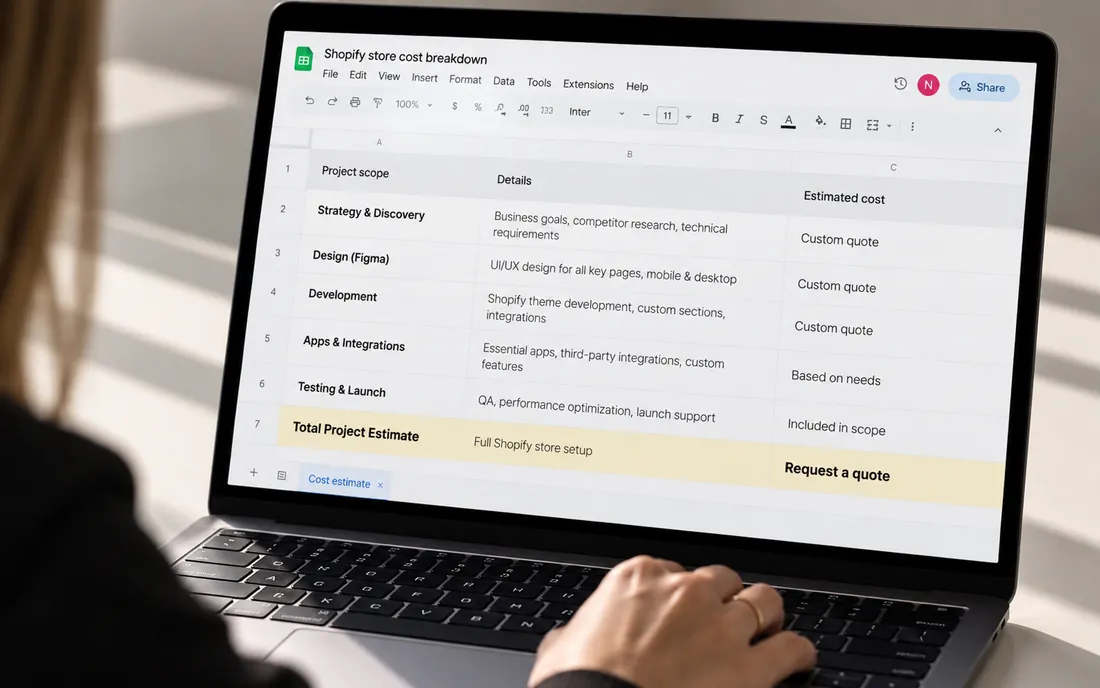 How much does a Shopify store cost
How Much Does a Shopify Store Cost in 2026?
A full breakdown of what a Shopify store really costs in 2026, from the monthly plan and payment fees to themes, apps and professional design and development.
Let's talk
Building a Shopify store for your supplements & wellness brand?
Book a call. We'll talk through your products, customers and launch plan, then send a written proposal.