Shopify for automotive
Shopify stores for auto parts and accessories brands
We design and build Shopify stores for automotive brands where the hardest part isn't the design. It's making sure every shopper finds the part that fits their vehicle.
What makes an auto parts store different?
Fitment. A shopper doesn't want "brake pads"; they want brake pads that fit a 2019 Ford F-150 with a specific trim and engine. If the store can't answer that quickly, they leave or they order the wrong part and send it back.
Automotive stores also tend to have very large catalogs, part numbers that buyers search by directly, supplier data that arrives in spreadsheets or industry XML, and some parts that are restricted or need warnings in certain states. Those are the problems we design around.
Does Shopify support year/make/model search?
Not natively. Shopify has no built-in vehicle database, so fitment search comes from a dedicated app or custom development on top of metafields and metaobjects.
Fitment apps on the Shopify App Store, such as Year Make Model by EasySearch, add a YMM selector, a saved "garage" for returning shoppers and a fitment table on each product page, with fitment data imported from CSV. When we compare options for a client, we check how each app imports data, how it handles very large fitment tables, and whether it works with your theme and search.
It's tempting to fake fitment with Shopify's native filters, but they don't scale for this. The Search & Discovery app allows up to 25 filters per store, shows up to 100 values per filter on the storefront, and doesn't display filters at all on collections with more than 5,000 products. A catalog covering decades of vehicles hits those limits quickly.
What are ACES and PIES?
They're the North American aftermarket's data standards, maintained by the Auto Care Association. ACES carries fitment (which part fits which vehicle) and PIES carries product information such as dimensions, descriptions and images.
If your suppliers send ACES and PIES files, ask any fitment app or PIM whether it can import them directly; some only take CSV. Access to the underlying vehicle reference database (VCdb) requires a paid Auto Care subscription. Getting this pipeline right matters more than any design decision, because it decides whether fitment stays accurate as the catalog grows.
How many variants can a Shopify product have?
Up to 2,048 variants and 3 options per product. Shopify raised the limit from 100 to 2,048 in October 2025.
For automotive, that headroom helps with parts sold in many sizes, finishes or bolt patterns. Fitment itself should not be modeled as variants; a vehicle isn't a product option, and one part can fit thousands of vehicles. A few practical limits to check:
- Some third-party themes, apps and sales channels still support only 100 variants per product.
- Products needing more than 3 options require an app or custom theme code using line item properties.
- Once a store reaches 500,000 variants, it can create at most 10,000 new variants per day through apps or CSV. Shopify Plus stores are exempt.
- Combined listings, which group separate products into one product page, are a Shopify Plus feature.
Which Shopify setup solves common automotive problems?
| Challenge | Shopify approach |
|---|---|
| Shoppers need parts that fit their vehicle | Fitment app with YMM selector, garage and fitment table |
| Supplier data in ACES/PIES or spreadsheets | App or PIM that imports the files; scheduled updates |
| Buyers search by part number or OEM number | Part and cross-reference numbers stored in metafields and indexed by search |
| Parts in many sizes and finishes | Up to 3 options and 2,048 variants per product |
| Shops and fleets buying at trade prices | Native B2B catalogs, quantity rules and net terms |
| Wrong-fit returns | Fitment confirmation on product and cart pages; clear return rules |
| Heavy or hazmat items (batteries, fluids) | Separate shipping profiles and carrier rules |
What compliance issues apply to auto parts sold online?
The big ones in the US are California emissions rules and Proposition 65. This isn't legal advice, so check your catalog with your compliance advisor.
- California (CARB): emissions-related performance parts can only be sold for use on pollution-controlled vehicles in California once CARB has issued an Executive Order. CARB has fined online retailers, including a $1.7 million settlement with JEGS, for selling non-approved parts. We add EO numbers to product data and can restrict shipping of non-approved parts to California.
- Proposition 65: online sellers must show the warning on the product page, through a clearly marked "WARNING" link, or before checkout is complete. Amendments in effect from January 1, 2025 added specific warning language for vehicle parts, with a compliance deadline of January 1, 2028.
- Selling into the EU: the General Product Safety Regulation requires online offers to show the manufacturer or EU responsible person, product identifiers and safety warnings.
How we build automotive stores
We start with your data: where fitment and product information come from, how often they change and who maintains them. Then we choose the fitment app or custom approach, design product and collection pages around "does this fit my car?", and build the import and search setup before launch. Our Shopify development and store design services cover the build, migrations cover moving an existing parts catalog, and selling to garages and fleets is covered by our B2B work. Not sure where your current store stands? Ask for a free Shopify audit.
Send us your store URL and we'll email you the fixes that matter most. No call needed.
Frequently asked questions
Can Shopify handle 100,000+ auto parts?
Yes, catalog size itself isn't the problem; data management is. Plan for bulk imports, an app or PIM for fitment, and Shopify's daily throttle of 10,000 new variants once a store passes 500,000 variants (Plus stores are exempt). Collections over 5,000 products also don't show native filters, so navigation relies on fitment search.
What's the best year/make/model app for Shopify?
It depends on your data. If suppliers send ACES files, pick an app or PIM that imports them; if you maintain fitment in spreadsheets, a CSV-based app may be enough. We compare import options, garage features, theme compatibility and pricing against your catalog before recommending one.
Should vehicle fitment be stored as variants?
No. Variants are for things the customer chooses, like size or finish, and Shopify caps them at 2,048 per product with 3 options. Fitment belongs in a fitment app or in metafields and metaobjects, where one part can map to thousands of vehicles.
Can I stop non-CARB-legal parts shipping to California?
Yes. We can flag those products in their data, show a clear notice on the product page and set shipping rules so they can't be delivered to California addresses. Your compliance advisor should confirm which parts need an Executive Order.
Can garages and fleets get trade pricing?
Yes. Native Shopify B2B, available on every plan from Basic up since April 2, 2026, gives company accounts, trade catalogs, quantity rules and net terms. Plus adds unlimited catalogs and company-specific price lists.
Sources
- Shopify Changelog: Product variant limit increased to 2,048
- Shopify Help Center: 2,048 variant limit
- Shopify Blog: 2048 variants
- Shopify Help Center: Search & Discovery filters
- Shopify.dev: Combined listings
- Shopify App Store: Year Make Model by EasySearch
- Auto Care Association: Aftermarket Catalog Exchange Standard (ACES)
- CARB: JEGS pays $1.7 million to settle case for selling illegal auto parts in California
- Kelley Drye: Prop 65 update on short-form and internet warnings
- EUR-Lex: Regulation (EU) 2023/988 on general product safety
- Shopify Help Center: Shopify B2B features by plan
Services
How we help automotive brands.
Shopify Development
Clean Shopify theme development: Online Store 2.0 sections, metafields, app integrations, speed work and bug fixes.
Shopify Store Design
Custom store design in Figma: homepage, collections, product pages and everything in between, built around how your customers buy.
Shopify Migration
Move from WooCommerce, Wix, Squarespace, Magento or BigCommerce to Shopify with your products, customers, orders and SEO intact.
Useful guides
All articles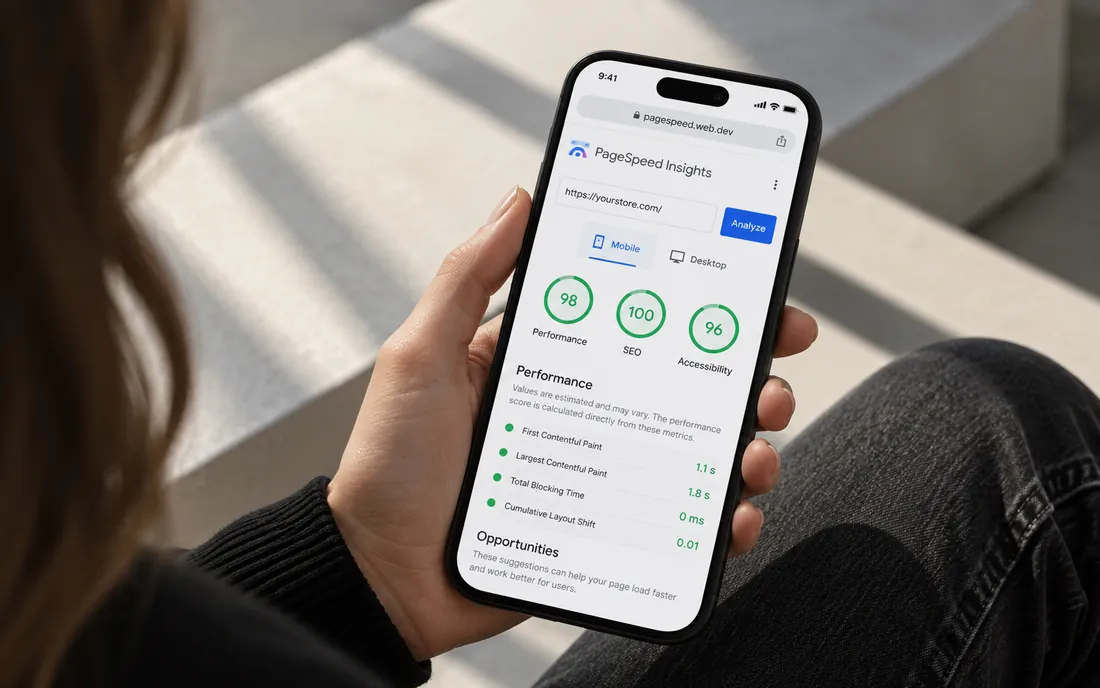 Shopify SEO
 Guide for 2026: Technical Fixes, Content and AI Search
A practical 2026 Shopify SEO guide covering the technical issues Shopify stores actually have, the content that ranks, and how to stay visible in AI search and agentic shopping.
 Shopify B2B without Plus
Shopify B2B Without Plus: What Basic, Grow and Advanced Can Do in 2026
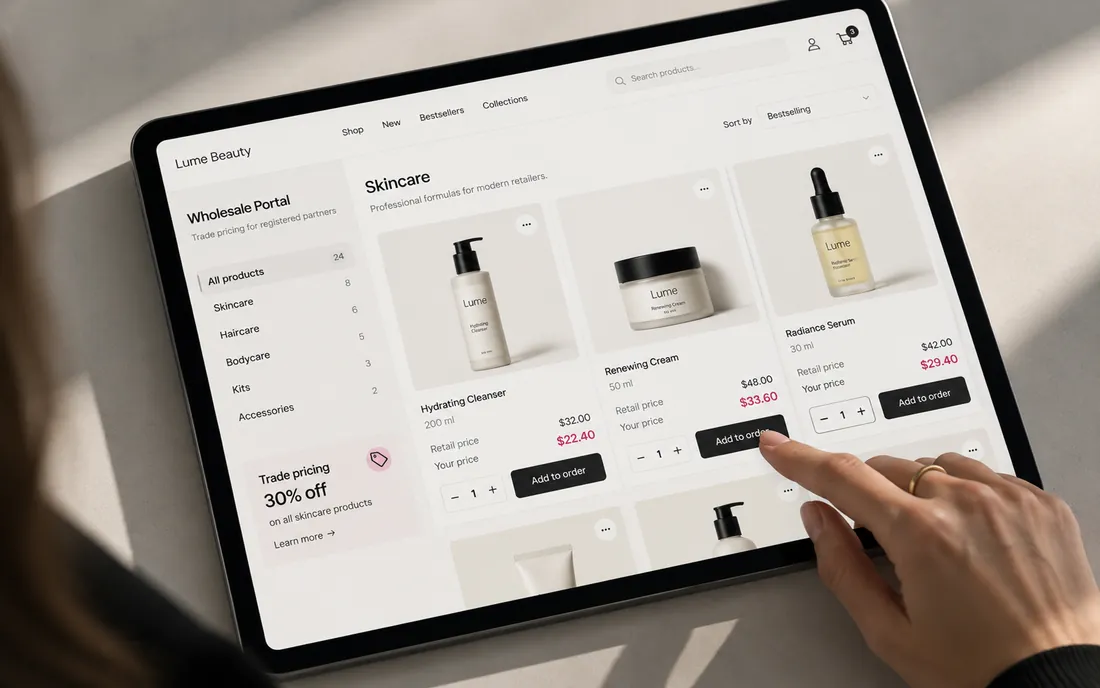
Since April 2026, native B2B works on every main Shopify plan. Here's what you get without Plus, where the 3-catalog limit bites, and when an upgrade makes sense.
Magento to Shopify Migration: A Practical Guide for 2026
Magento 1 has been unsupported since 2020 and several Magento 2.4 versions are leaving support. Here's how to move a complex Magento catalog, B2B setup and SEO to Shopify.
Let's talk
Building a Shopify store for your automotive brand?
Book a call. We'll talk through your products, customers and launch plan, then send a written proposal.