Shopify for food & beverage
Shopify for food and beverage brands
Food stores live or die on repeat orders and on getting the label information right. We build Shopify stores that handle both.
Is Shopify good for food and drink brands?
Yes. Coffee roasters, snack brands, bakeries, wineries and specialty grocers all run well on Shopify. The platform handles subscriptions, bundles, wholesale and local delivery without custom code.
What makes food different is information and logistics. Every product page is effectively a label, perishables need different shipping than shelf-stable goods, and margins depend on customers reordering.
What food information has to be on a product page?
In the EU, all mandatory food information for prepacked food, except the best-before or use-by date, must be available before the purchase is completed, and everything must be available at delivery.
That comes from Article 14 of Regulation (EU) No 1169/2011. In practice it means the name of the food, ingredients, allergens, net quantity, storage conditions, the business name and address, nutrition declaration and other required particulars on the product page, not only on the pack. The regulation lists 14 allergens that must be emphasized in the ingredient list. For non-prepacked food (for example a bakery's fresh bread), allergen information is the key requirement before purchase.
In the US, the FDA recognizes nine major food allergens: milk, eggs, fish, crustacean shellfish, tree nuts, peanuts, wheat, soybeans and sesame, which was added from January 1, 2023.
How we build it: ingredients, allergens, nutrition and storage are stored as metafields and rendered in a consistent label block on every product, so nothing depends on someone remembering to paste it into a description.
Food store challenges and the Shopify solution
| Challenge | Shopify solution | Native or app |
|---|---|---|
| Ingredients, allergens, nutrition on every product | Metafields plus a theme label block | Native (theme work) |
| Price per kg or per liter | Unit pricing on products and variants | Native |
| Coffee or tea on repeat | Shopify Subscriptions (weekly, monthly, yearly) | Free first-party app |
| Fresh goods vs shelf-stable shipping | Shipping profiles with product-specific rates | Native |
| Fresh delivery in your city | Local delivery zones and pickup in store | Native (slots need an app) |
| Gift boxes and multipacks | Shopify Bundles (fixed bundles, multipacks) | Free first-party app |
| Selling to cafes and retailers | Native B2B on Basic, Grow and Advanced | Native |
| Alcohol age checks | Age confirmation and restricted shipping zones | App or theme work |
How do you ship perishable food with Shopify?
Separate perishables into their own shipping profile, limit where and when they ship, and use local delivery or pickup for anything that cannot survive a courier network.
Shopify's shipping profiles let chilled products carry their own rates and zones while dry goods use your general rates. For fresh goods in your area, native local delivery covers a radius or postal codes with minimum order values. Two common additions: a ship-day restriction (no chilled dispatch on Thursdays or Fridays so parcels do not sit over the weekend) and a delivery date picker, both from apps. In the EU, goods that deteriorate rapidly are exempt from the 14-day withdrawal right, but you still need a clear policy for damaged or warm deliveries.
Can you sell alcohol on Shopify?
Yes, if you are licensed. Shopify's guidance is that merchants must hold every license needed to make, market, sell and deliver alcohol and follow local age rules.
The legal age to buy is 21 in the US and 18 in the UK, and US rules vary by state. We add age confirmation, restrict shipping to markets you are licensed for, and keep wine and spirits clearly separated if you also sell food to a wider audience.
What about health and nutrition claims?
Be careful with words like "boosts immunity" or "high protein". In the EU, nutrition and health claims are governed by Regulation (EC) No 1924/2006 and must be accurate, evidence-based and not misleading; the EU Register lists which claims are authorized. In the US, the FDA and FTC regulate label and advertising claims. We flag risky claims in copy reviews, but final wording should be checked by your regulatory advisor.
What should a food website design prioritize?
- Appetite appeal. Real photography of the product in use beats packshots alone.
- Subscribe and save on the product page, with the saving and the cadence visible, and easy skip or pause.
- A readable label block with allergens visible at a glance, not hidden in a collapsed tab nobody opens.
- Gifting for peaks like the holidays: gift boxes, gift messages and corporate gifting orders.
- Wholesale entry point for cafes, delis and retailers, using native B2B without Plus.
How we build food and beverage stores
We start with your product data: ingredients, allergens, nutrition, storage and claims, structured once and displayed everywhere. Then we design the store, set up subscriptions, shipping profiles and local delivery, and add wholesale if you sell to trade. See Shopify store design, Shopify development and Shopify B2B.
Send us your store URL and we'll email you the fixes that matter most. No call needed.
Frequently asked questions
Do I have to show allergens on my online food store?
In the EU, yes. For prepacked food, all mandatory food information except the date marking must be available before purchase, and allergens must be emphasized. For non-prepacked food, allergen information is required before purchase and at delivery.
Can I sell coffee subscriptions on Shopify?
Yes. The free Shopify Subscriptions app supports weekly, monthly and yearly plans with subscribe-and-save discounts, and customers can skip, pause or cancel from their account. Brands that need prepaid plans or advanced build-a-box flows often use a third-party subscription app.
How do I ship frozen or chilled food with Shopify?
Put those products in their own shipping profile with dedicated rates and zones, use insulated packaging, and restrict dispatch days so parcels do not sit over a weekend. For local customers, Shopify's native local delivery and pickup are often the safest option.
Can Shopify show price per kilogram?
Yes. Unit pricing is native and appears on product, collection, cart and checkout pages in Online Store 2.0 themes. Displaying unit prices is a legal requirement in some regions, including the EU for many food products.
Can I sell wholesale to cafes and shops from the same store?
Yes. Since April 2026, native Shopify B2B is available on Basic, Grow and Advanced with company profiles, up to three B2B catalogs, volume pricing and payment terms. Shopify Plus adds unlimited catalogs and more checkout control.
Sources
- European Commission: Distance selling of food (Regulation (EU) No 1169/2011)
- Food Safety Authority of Ireland: Labelling and distance selling
- EUR-Lex: Regulation (EU) No 1169/2011 on food information to consumers
- U.S. FDA: Food allergies and the nine major food allergens
- European Commission: Nutrition and health claims (Regulation (EC) No 1924/2006)
- Shopify Help Center: Metafields
- Shopify Help Center: Unit pricing
- Shopify Help Center: Shopify Subscriptions
- Shopify App Store: Shopify Subscriptions
- Shopify Help Center: Shipping profiles
- Shopify Help Center: Setting up local delivery for online orders
- Shopify App Store: Shopify Bundles
- Shopify Help Center: Shopify B2B
- Shopify Help Center: Selling alcohol products
- EUR-Lex: Consumer Rights Directive 2011/83/EU (Article 16 exceptions)
Services
How we help food & beverage brands.
Shopify Store Design
Custom store design in Figma: homepage, collections, product pages and everything in between, built around how your customers buy.
Shopify Development
Clean Shopify theme development: Online Store 2.0 sections, metafields, app integrations, speed work and bug fixes.
Shopify B2B & Wholesale
Native Shopify B2B: company accounts, wholesale catalogs, volume pricing, payment terms and a buyer portal, on one store with your DTC site.
Useful guides
All articles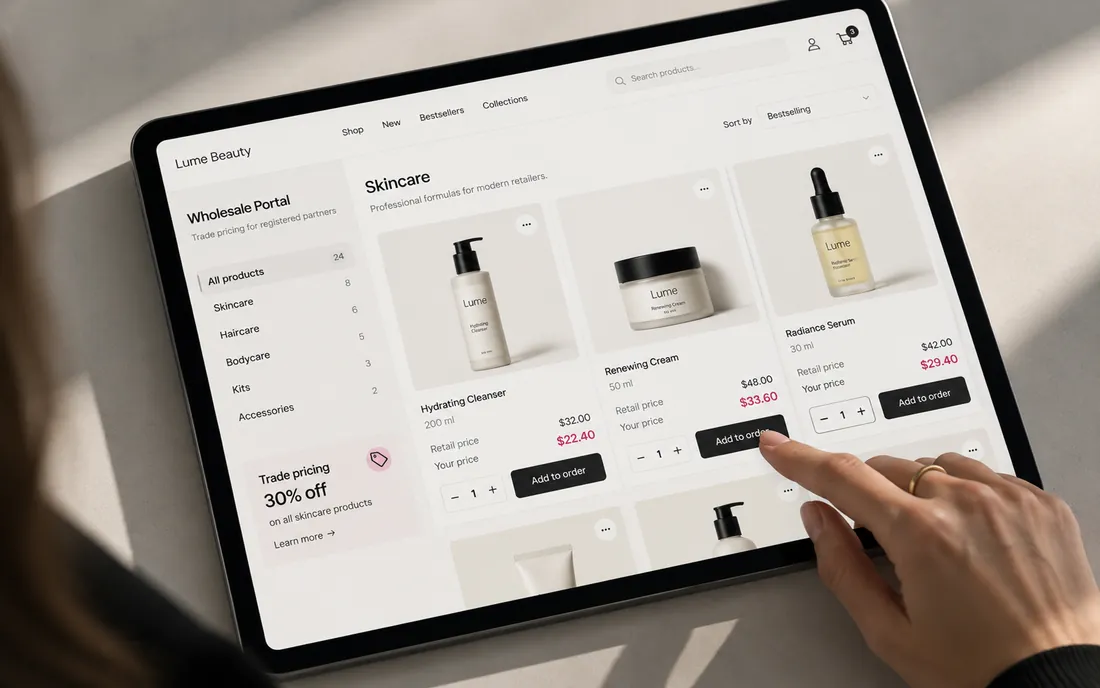 Shopify B2B without Plus
Shopify B2B Without Plus: What Basic, Grow and Advanced Can Do in 2026
Since April 2026, native B2B works on every main Shopify plan. Here's what you get without Plus, where the 3-catalog limit bites, and when an upgrade makes sense.
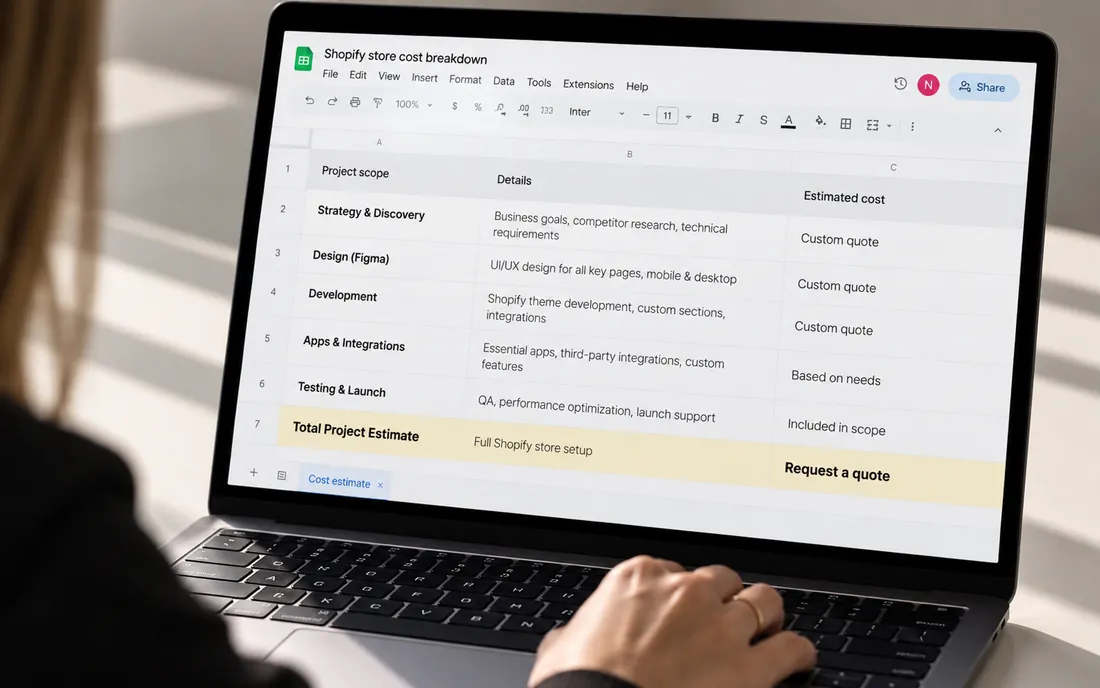 How much does a Shopify store cost
How Much Does a Shopify Store Cost in 2026?
A full breakdown of what a Shopify store really costs in 2026, from the monthly plan and payment fees to themes, apps and professional design and development.
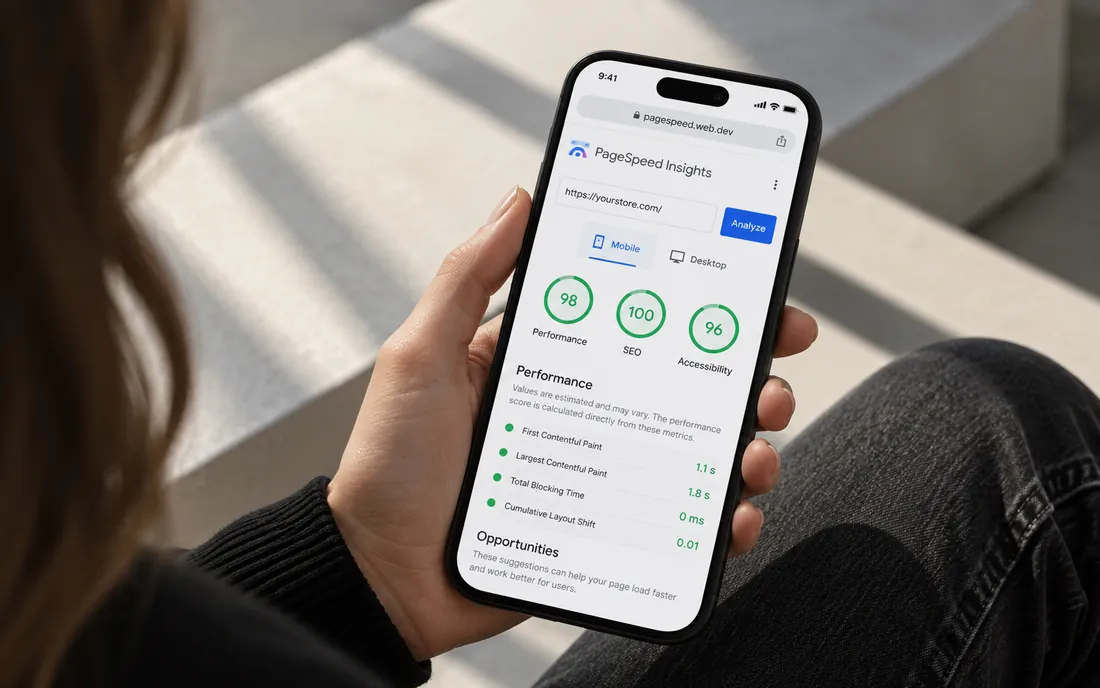 Shopify SEO
 Guide for 2026: Technical Fixes, Content and AI Search
A practical 2026 Shopify SEO guide covering the technical issues Shopify stores actually have, the content that ranks, and how to stay visible in AI search and agentic shopping.
Let's talk
Building a Shopify store for your food & beverage brand?
Book a call. We'll talk through your products, customers and launch plan, then send a written proposal.