B2B & Plus
Shopify for Textile Brands and Manufacturers: B2C + Wholesale in One Store
Key takeaways
- Sell fabric by length with fixed-length units and quantity, or a calculator app that saves the cut length as a line item property.
- Shopify allows 2,048 variants but only 3 options per product, which textile catalogs hit quickly.
- Native B2B on Basic, Grow and Advanced covers trade catalogs, MOQs, increments and volume pricing.
- EU Regulation 1007/2011 requires fiber composition to be clearly visible before purchase, including online.
- Show OEKO-TEX and GOTS claims only on certified products, with the details each standard requires.
Is Shopify a good platform for textile brands and manufacturers?
Yes, if the store is built around how textiles are actually bought. Shopify handles variants, unit prices, samples and native B2B well; the work is in modeling lengths, widths and colorways correctly and showing the information textile buyers and regulators expect before purchase.
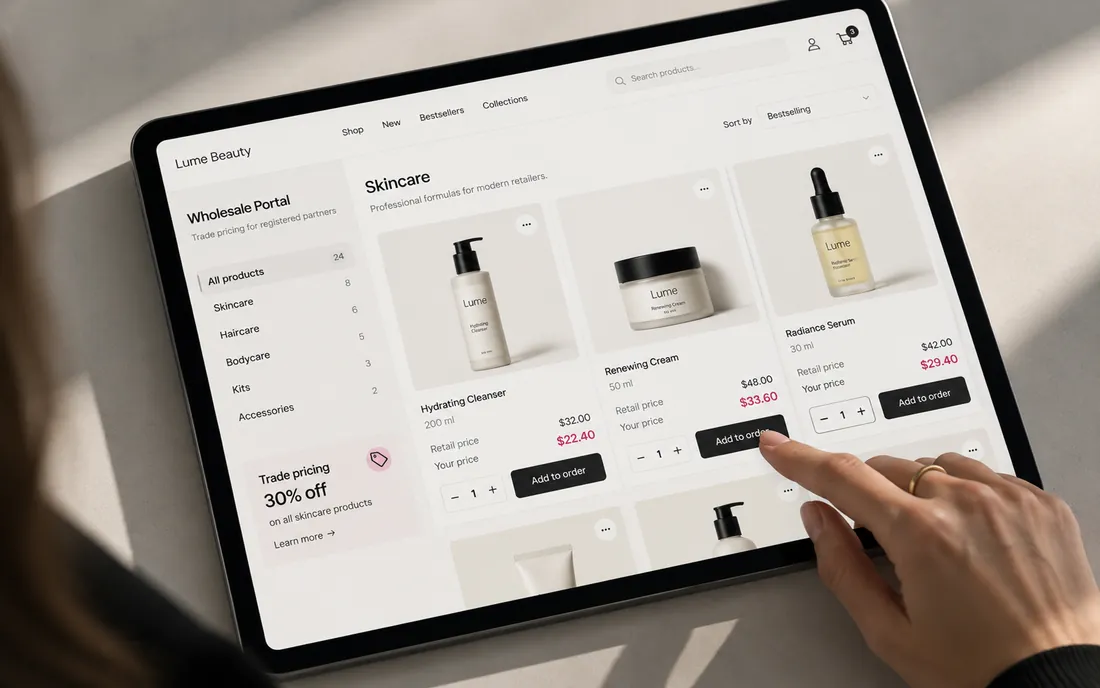
Textile businesses rarely sell one way. A bedding brand sells sets to consumers and cases to hotels. A fabric mill sells cut lengths to home sewers and full rolls to upholsterers. A store that treats these as two separate websites doubles the work. Shopify lets you run both from one catalog, with consumers and trade buyers seeing different prices, minimums and payment terms.
How do you sell fabric by the meter on Shopify?
The simplest approach is to make one unit equal a fixed length, such as 0.5 m or 10 cm, and let the quantity selector do the rest. For truly custom cut lengths, a price calculator app or custom theme code captures the length and prices the line item.
- Fixed increments: price the variant per 0.5 m (or per yard for US buyers) and explain on the page that quantity 3 means 1.5 m in one continuous piece. It works with every theme and keeps inventory exact.
- Custom length: a measurement or price-calculator app asks for the length and calculates the price. The length is stored as a line item property, so it appears on the order for the cutting table.
- Width as a variant: when a fabric comes in 140 cm and 280 cm widths, make width an option and price each variant separately.
Show a base price per meter too. Shopify's unit pricing supports lengths in Online Store 2.0 themes, and in Germany the Price Indication Ordinance (PAngV) requires a base price for goods offered to consumers by length, typically per 1 meter.
How many color and pattern variants can a Shopify product have?
Up to 2,048 variants and 3 options per product. That's enough for most fabrics, even with many colorways, widths and finishes, but the 3-option limit is the one textile catalogs hit first.
A towel collection with color, size and weight, or a curtain fabric with color, width and lining, already uses all three. Any further choice, such as hemming or a custom length, goes into line item properties or an app. For large color ranges, consider one product per colorway so each gets its own photos, URL and place in collections. Shopify's Combined Listings can link such products on one page for qualified Shopify Plus merchants; on other plans we link colorways with metafields and a swatch section.
How should textile stores handle swatches and samples?
Treat samples as a product in their own right. Interior designers and upholsterers order samples before committing to rolls, and a smooth sample flow often decides whether the full order follows.
- Sample variant on each fabric, next to the per-meter variant, so samples share photos and reviews.
- Sample limits, for example a maximum per order, using quantity limits in the theme or an app.
- Sample-only shipping rates that are cheap or free for letter-sized parcels.
- Batch or dye-lot information where colors vary between production runs, so customers order the full length at once.
How do trade pricing, MOQs and volume pricing work on Shopify?
Through Shopify's native B2B, included on Basic, Grow and Advanced since April 2, 2026. Trade buyers belong to a company, see a B2B catalog with their prices, and must follow quantity rules that you set per variant.
- Minimum order quantities and increments: for example, minimum 10 m, sold in 5 m steps, or full rolls only.
- Volume pricing: up to 10 price breaks per product, applied per variant.
- Payment terms such as net 30, and vaulted cards for repeat orders.
- Catalogs: 3 active catalog assignments on Basic, Grow and Advanced; unlimited on Plus, which also adds deposits for large production orders.
Quantity rules apply per variant, so a buyer can't combine colors to reach a minimum. Native quantity rules are part of B2B catalogs; for consumer-facing minimums you need an app or theme logic. Read our guide to Shopify B2B without Plus for the details.
What textile labelling information must appear online?
In the EU, the fiber composition must be clearly visible before purchase, including online. In the US, internet descriptions must state country of origin, and fiber content must be shown whenever you make a fiber claim. Store this as structured product data, not buried in descriptions.
| Requirement | EU (Regulation 1007/2011) | US (FTC) |
|---|---|---|
| Fiber composition online | Must be clearly visible before purchase, including for online sales (Art. 16) | Required in ads that mention or imply a fiber; percentages not required in the ad |
| Language | Official language(s) of the country where you sell, unless that country provides otherwise | English |
| Country of origin online | Not required by this regulation | Required: Made in USA, imported, or both |
| Scope | Textile products and products with at least 80% textile fibers by weight | Most apparel, home textiles and yard goods |
| Care information | Not mandated; ISO 3758 symbols are voluntary | Required for apparel and piece goods for home sewing (Care Labeling Rule) |
For fabric sold by the yard in the US, care instructions belong on the end of each bolt; in an online store, we also show them on the product page. Use EU fiber names exactly as the regulation lists them, and translate them for each market you sell in. If you sell into Germany, see how we handle German legal requirements.
How do you make OEKO-TEX and GOTS claims correctly?
Only for the products that are actually certified, and only with the wording and details the standard allows. A sitewide "all our fabrics are organic" banner is the classic mistake.
- OEKO-TEX: claims require a correctly labeled product with a valid certificate, and OEKO-TEX publishes pre-approved claim wording; anything else needs its approval first.
- GOTS: product listings must show the GOTS logo, the label grade, a reference to the certification body and the certification number. "Organic" requires at least 95% certified organic fibers; "made with x% organic materials" applies from 70% to 94%. GOTS says its logo shouldn't sit in site headers or footers.
- EU green claims: since September 27, 2026, the Empowering Consumers Directive (EU) 2024/825 bans generic environmental claims like "eco-friendly" that you can't substantiate, and requires sustainability labels to be based on a certification scheme or established by public authorities.
On Shopify, we store certificate numbers, label grades and expiry dates in metafields per product, so a badge appears only where it's true. Check final wording with the certification body or your legal advisor.
What product photography do textile buyers need?
Photos that answer touch-and-feel questions: texture, drape, weight, color and scale. Textile returns often come from colors that looked different on screen or patterns that were larger than expected.
- Macro shots of weave and surface texture.
- Drape and fold shots that show weight and stiffness.
- Scale references: a ruler or hand next to the pattern repeat, and room or garment shots.
- Color-accurate images shot under consistent light, with a note that screens vary.
- Specs beside the photos: width, weight (g/m²), composition, pattern repeat, care and certifications.
Which Shopify features solve common textile challenges?
| Textile challenge | Shopify solution |
|---|---|
| Selling by length | Fixed-length units with quantity, or a calculator app with line item properties |
| Base price per meter | Native unit pricing in Online Store 2.0 themes |
| Many colorways and widths | Up to 2,048 variants and 3 options; separate colorway products linked by metafields |
| Samples and swatches | Sample variants, sample shipping rates, quantity limits |
| Trade prices and MOQs | Native B2B: catalogs, quantity rules, volume pricing, payment terms |
| Fiber composition and care | Metafields shown as a specs block and used as filters |
| Certifications | Per-product metafields for OEKO-TEX or GOTS details |
| Multiple countries | Shopify Markets with translated fiber names and local currencies |
How we build textile stores
We start with the catalog model: units, widths, colorways and where samples sit, because every later decision depends on it. Then we design the product page around specs and imagery, and set up B2B with catalogs and quantity rules so trade buyers and consumers share one store. We've worked with wholesale manufacturers and factories, and we apply the same thinking from our home decor and wallpaper, fashion and apparel and wholesale manufacturer work. See our Shopify B2B services to learn how we'd approach your store.
Send us your store URL and we'll email you the fixes that matter most. No call needed.
Frequently asked questions
Can Shopify sell fabric in fractions of a meter?
Not as fractional quantities, because Shopify quantities are whole numbers. Set one unit to a fixed length, such as 10 cm or 0.5 m, or use a price calculator app that lets customers enter a custom length and stores it on the order as a line item property.
Do I have to show fiber composition on my product pages?
If you sell in the EU, yes. Regulation 1007/2011 requires fiber composition to be clearly visible to consumers before purchase, including for online sales, in the language of the country where you sell. In the US, the FTC requires fiber content in ads that mention fibers, and country of origin in internet descriptions.
Can trade customers and consumers use the same Shopify store?
Yes. With native Shopify B2B, trade buyers log in as part of a company and see their own catalog prices, minimum quantities, volume breaks and payment terms, while consumers see retail prices. Basic, Grow and Advanced allow 3 active catalog assignments; Plus is unlimited.
Can I set a minimum order of 10 meters for wholesale buyers?
Yes. Quantity rules in a B2B catalog let you set a minimum, a maximum and an increment per variant, for example a minimum of 10 units of 1 m in steps of 5. The rules apply per variant, so buyers can't mix colors to reach the minimum.
Can I put an OEKO-TEX badge on all my products?
Only on products covered by a valid certificate. OEKO-TEX requires a correctly labeled product for any claim and publishes approved wording. Since September 27, 2026, EU rules also require sustainability labels to be based on a certification scheme, so blanket badges are a real risk.
Sources
- EUR-Lex: Regulation (EU) No 1007/2011 on textile fibre names and labelling
- legislation.gov.uk: Regulation 1007/2011, Article 16
- ComplianceGate: Textile labelling requirements in the EU (third-party)
- FTC: Threading your way through the labeling requirements under the Textile and Wool Acts
- FTC: Clothes Captioning, complying with the Care Labeling Rule
- OEKO-TEX Labelling Guide: Claims usage
- GOTS: Labelling resources
- European Commission Transition Pathways: Directive (EU) 2024/825
- Gesetze im Internet: § 4 PAngV (Grundpreis)
- Gesetze im Internet: § 5 PAngV (Mengeneinheiten)
- Shopify Help Center: Adding variants
- Shopify Help Center: Unit pricing
- Shopify.dev: Product template and line item properties
- Shopify: Combined Listings
- Shopify Help Center: B2B features by plan
- Shopify Help Center: Quantity rules and volume pricing