Shopify for korean skincare (k-beauty)
Shopify stores for Korean skincare brands and retailers
K-beauty shoppers buy routines, not single products, and regulators treat imported cosmetics carefully. We build Shopify stores for Korean skincare brands going abroad and for retailers importing them.
What makes a K-beauty store different from other skincare stores?
Three things. Shoppers build multi-step routines and want to know what goes in which order. They compare ingredients closely, often searching for a specific one such as centella, snail mucin or rice. And they worry about fakes, because grey-market and counterfeit Korean skincare is common on marketplaces.
The store has to answer all three on every product page, while staying compliant in each country it ships to.
How do you sell skincare routines on Shopify?
- Routine steps as data: each product carries a step (cleanse, tone, treat, moisturize, protect) in a metafield, so the theme can show "step 3 of 6" and suggest what comes next.
- Bundles: Shopify's free Bundles app creates fixed routine sets with their own price, while inventory stays tracked per product.
- Skin-type and concern filters: dry, oily, combination, sensitive; acne, pigmentation, barrier repair. Built with Search & Discovery filters on metafields.
- A quiz that recommends a routine and adds it to the cart in one step.
- Subscriptions for refills such as toner pads and sunscreen, which run out on a predictable schedule.
What information must a K-beauty product page show?
The full ingredient list (INCI names), the size, how to use it, the period after opening or expiry date, warnings, and the responsible person for the market the shopper is in. In the EU and UK, label information must be in the local language on the product itself; your product page should match it.
Skincare claims are regulated too. "Brightening" and "soothing" are cosmetic claims; "treats acne" or "removes eczema" turn a cosmetic into a medicine in most markets. We keep claims in the metafields reviewable, so one compliance check covers the whole catalogue.
Which rules apply to selling Korean skincare in the EU, UK and US?
| Market | What applies | What it means for the store |
|---|---|---|
| EU | Cosmetics Regulation (EC) 1223/2009 | An EU-based responsible person, product notification in the CPNP portal, a safety report and EU-compliant labels before selling |
| Great Britain | UK cosmetics rules retained after Brexit | A UK responsible person and notification in the SCPN portal, separately from the EU |
| US | Modernization of Cosmetics Regulation Act (MoCRA) | Facility registration and product listing (enforced since July 1, 2024), safety substantiation, serious adverse event reports within 15 business days |
| US sunscreen | Over-the-counter drug rules | Only FDA-approved UV filters; many Korean formulas need a US version |
If you import from Korea and resell, these obligations sit with whoever places the product on that market. Retailers usually rely on the brand's notifications, so ask for proof before listing a product for a country.
Can you sell Korean sunscreen in the US?
Only formulas that meet US rules. In the US, sunscreen is an over-the-counter drug, not a cosmetic, and may use only UV filters the FDA allows. The FDA approved bemotrizinol in June 2026, the first new filter in decades, but popular Korean formulas often combine filters that are still not approved in the US, such as Uvinul A Plus and Tinosorb M. Those need reformulation before they can be sold there.
On Shopify, we handle this with market-specific availability: a sunscreen can be sold to EU and UK customers and hidden from US customers, using Shopify Markets and product publishing per market.
How do you prove authenticity online?
- State whether you are the brand, an authorized distributor or a retailer, and show authorization letters where brands allow it.
- Show batch codes and expiry dates in product photos or on request.
- Keep supplier invoices, because marketplaces and payment providers may ask for them.
How we build K-beauty stores
We build the routine logic, skin-type filters, quiz, bundles and subscriptions, and set up Shopify Markets so each product sells only where it's compliant. We've built skincare stores such as KIN Cosmetics. See our beauty and skincare page for skincare more broadly, or our store design service.
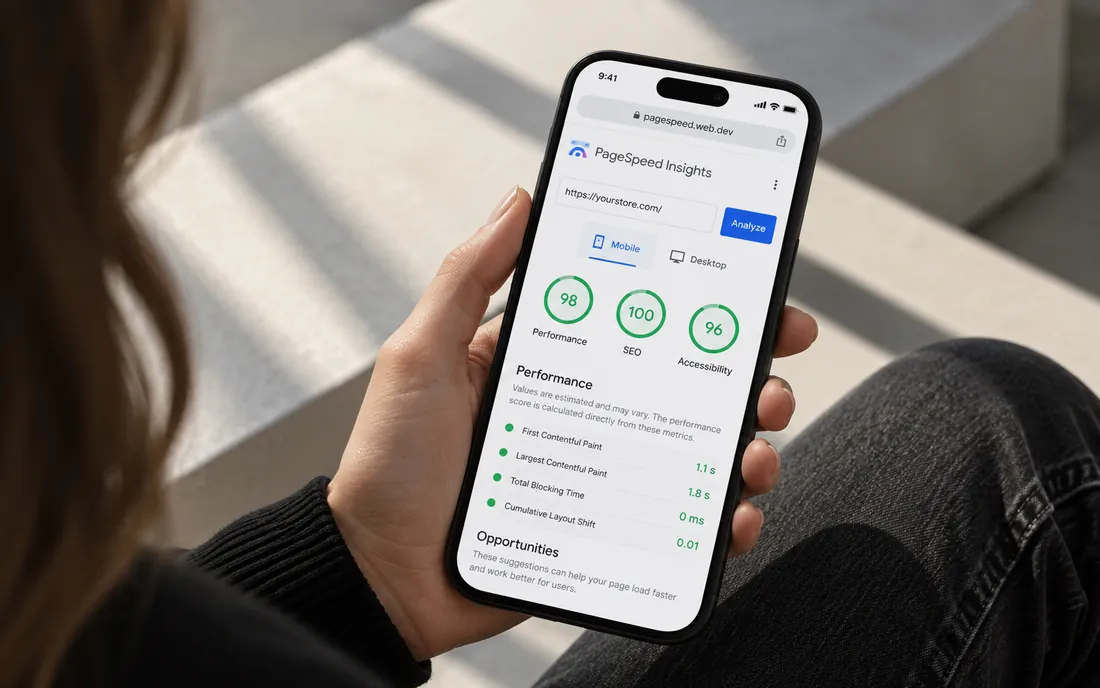
Send us your store URL and we'll email you the fixes that matter most. No call needed.
Frequently asked questions
Do I need an EU responsible person to sell Korean skincare in Europe?
Yes. Under the EU Cosmetics Regulation, every cosmetic placed on the EU market needs an EU-based responsible person and a notification in the CPNP portal before it's sold. Great Britain has a separate requirement for a UK responsible person and SCPN notification.
What is MoCRA and does it affect K-beauty stores?
MoCRA is the US Modernization of Cosmetics Regulation Act. It requires facility registration, product listing, safety substantiation and reporting of serious adverse events within 15 business days. Registration and listing have been enforced since July 1, 2024. Certain small businesses are exempt from some requirements.
Can I sell Korean sunscreen to US customers?
Only if the formula uses UV filters the FDA allows, because sunscreen is an over-the-counter drug in the US. Many Korean sunscreens use filters not approved in the US, so use Shopify Markets to hide those products from US customers.
How do I build a skincare routine bundle on Shopify?
Use Shopify's Bundles app for fixed sets with their own price, or a routine builder that lets customers pick one product per step. Inventory stays tracked per product, so a bundle can't sell when one of its items is out of stock.
Can a Shopify store show different products in different countries?
Yes. With Shopify Markets you can publish products to some markets and not others, set local prices and currencies, and show market-specific content. That's how we keep non-compliant products off the markets where they can't be sold.
Sources
- FDA: Modernization of Cosmetics Regulation Act of 2022 (MoCRA)
- Crowell: FDA final guidance on facility registration and product listing
- Exponent: FDA delays MoCRA enforcement until July 2024
- EUR-Lex: Regulation (EC) No 1223/2009 on cosmetic products
- GOV.UK: Cosmetic products enforcement regulations, Great Britain
- The Korea Times: US approves new UV filter (August 13, 2026)
- Shopify Help Center: Shopify Bundles
Services
How we help korean skincare (k-beauty) brands.
Shopify Store Design
Custom store design in Figma: homepage, collections, product pages and everything in between, built around how your customers buy.
Shopify Development
Clean Shopify theme development: Online Store 2.0 sections, metafields, app integrations, speed work and bug fixes.
Shopify SEO & CRO
Shopify SEO as a one-time setup, an ongoing monthly plan, or a roadmap your team carries out, plus AI-search readiness and conversion fixes.
Useful guides
All articlesShopify Markets: How to Sell Internationally From One Store
How to set up Shopify Markets for currencies, languages, subfolders, duties and local payment methods, plus the EU VAT, UK and US tax rules international sellers keep asking about.
Shopify Theme vs Custom Design: Which Is Right for Your Store?
Premium theme, customized theme or fully custom design? An honest comparison of cost, speed, flexibility and maintenance, with clear guidance on when each makes sense.
 Shopify SEO
: The Complete Guide for 2026 (Technical Fixes, Content and AI Search)
A practical 2026 Shopify SEO guide covering the technical issues Shopify stores actually have, the content that ranks, and how to stay visible in AI search and agentic shopping.
Other industries
Let's talk
Building a Shopify store for your korean skincare (k-beauty) brand?
Book a call. We'll talk through your products, customers and launch plan, then send a written proposal.