B2B & Plus
How Shopify B2B Price Lists and Catalogs Work (2026 Guide)
Key takeaways
- A catalog is Shopify's B2B price list: products, prices, volume pricing and quantity rules in one place.
- Fixed prices override the catalog's percentage adjustment, and volume pricing overrides it too.
- When a Plus company location has several catalogs, the store shows the lowest price; a location catalog beats a market catalog.
- Basic, Grow and Advanced allow up to 3 active catalog assignments across all B2B markets; Plus has no such limit.
- Prices can be imported by CSV, using SKU to match products.
What is a catalog in Shopify B2B?
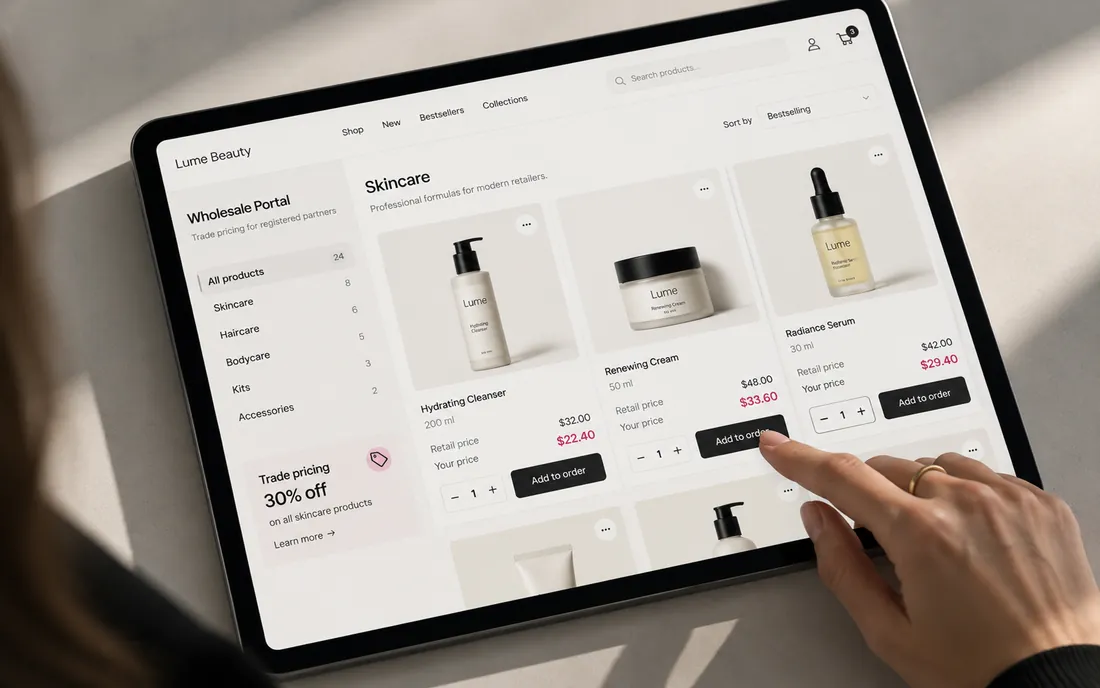
A catalog is Shopify's name for a B2B price list. It controls which products your business customers see and what they pay. Shopify's help center says you can include or exclude products, apply percentage price adjustments and set fixed prices, and each catalog can also carry quantity rules and volume pricing.
If you're coming from the old Wholesale channel or a tag-based app, think of it this way: instead of tagging customers and hiding prices with code, you create a catalog and assign it to the right buyers. The buyer logs in, picks the company location they're ordering for, and sees that catalog's prices.
How do you set prices in a B2B catalog?
There are two ways, and you can use both in the same catalog.
- Percentage adjustment: raise or lower all prices in the catalog by a percentage. A wholesale catalog at 40% off retail is the usual starting point.
- Fixed prices: set an exact price for a product (all variants) or for specific variants. Shopify notes that fixed prices override any overall adjustment you set.
So a common setup is "30% off everything, except these 20 products with negotiated fixed prices". By default, all products are included in a new catalog; you exclude the ones trade customers shouldn't see. You can also turn on automatic inclusion so new products join the catalog when you publish them.
The catalog has its own currency setting, but that doesn't decide which currency buyers see in the online store. Shopify bases the storefront currency on the customer's market.
How do volume pricing and quantity rules work?
Both live inside the catalog and are set per product or variant.
| Feature | What it does | Rules to know |
|---|---|---|
| Quantity rules | Minimum, maximum and increment per order (for example, cases of 12) | Rules apply to each variant on its own. Five grey hats and five blue hats don't add up to an increment of 10. |
| Volume pricing | Lower unit prices at higher quantities | Up to 10 price breaks per product, applied to each variant. Break quantities must be above the minimum and a multiple of the increment. |
One detail that catches people out: when a product has volume pricing, the catalog's overall percentage adjustment no longer applies to it. Shopify says any overall adjustment set on the catalog won't apply. Set the break prices as the real prices you want buyers to pay.
Also check your theme. Shopify advises that if you set a minimum, your theme should show it on the product page, so buyers know how many to add. Many themes need a small change to display minimums, increments and price breaks clearly.
How are catalogs assigned to customers?
In B2B, your customers are companies, and each company has one or more locations (a head office, stores, warehouses). Catalogs reach them in two ways:
- Through a B2B market: you assign the catalog to a B2B market, and every company location in that market gets its products and prices. This works on all plans with B2B.
- Directly to a company location: on Shopify Plus you can assign a catalog to a specific location. This is how you give one customer a negotiated price list.
On Basic, Grow and Advanced you can have up to 3 active catalog assignments across your active B2B markets. Assigning the same catalog to two markets counts as two. Plus has no such limit. Our guide to Shopify B2B without Plus explains when those 3 assignments are enough.
Which price applies when a buyer has several catalogs?
Shopify's documentation covers two cases:
- Several catalogs assigned directly to one location (Plus): if they include the same product at different prices, the store shows the lowest price, not counting quantity rules or volume pricing breaks. If prices tie, the quantity rules from the catalog created first are used.
- A location catalog plus a market catalog: the most specific price wins. The catalog assigned directly to the location takes priority over the market's catalog.
Because price breaks aren't part of the "lowest price" comparison, developers have reported cases where Shopify picks the older catalog even though a newer one has a better break at the ordered quantity. If you stack catalogs, test real orders at each break before going live, or keep one catalog per location so there's no contest.
Can you import B2B prices by CSV?
Yes. Open a catalog, choose Adjust prices, then Import CSV, preview and import. You can also update several catalogs in bulk. A few rules from Shopify's help center:
- The Catalog Title and Fixed Price fields must be filled, and Option1 Name and Option1 Value are required for every product.
- Products are matched by SKU. Products without a SKU need the Handle plus option columns.
- Leaving Fixed Price and Compare At blank removes that fixed price from the catalog.
- Exports only include products with fixed prices. Prices from percentage adjustments aren't exported.
If prices come from an ERP, a sync app or a custom integration through the Admin API usually replaces manual CSVs once you have more than a few price lists.
How should you structure catalogs for a wholesale business?
Start simple and add catalogs only when a real pricing difference needs one.
- One wholesale tier: one catalog with a percentage discount and a few fixed prices. Works on any plan.
- Two or three tiers (for example retailers, distributors, key accounts): one catalog per tier, each in its own B2B market. Fits inside the 3-assignment limit on non-Plus plans.
- Negotiated pricing per customer: catalogs assigned to company locations, which needs Plus, or a B2B app that handles customer-specific pricing on a lower plan.
- Regional wholesale (EU and US, for example): separate markets and catalogs per region, with currency set by the market. Count your assignments carefully on non-Plus plans.
Write the price logic down in a simple table before anyone touches the admin: who gets which catalog, which products are excluded, which have fixed prices and where the breaks are. Most B2B pricing problems start with catalogs added one at a time without a plan.
How we can help
We set up Shopify B2B stores with catalogs, volume pricing, quantity rules and the theme changes buyers need to see them, and we tell you plainly whether you need Plus. See our Shopify B2B services, read the full Shopify B2B features guide, or tell us about your price lists.
Send us your store URL and we'll email you the fixes that matter most. No call needed.
Frequently asked questions
Does Shopify have price lists for B2B?
Yes. Shopify calls them catalogs. A catalog sets which products a B2B customer sees and their prices, using a percentage adjustment, fixed prices, volume pricing and quantity rules.
Can each B2B customer have their own price list on Shopify?
On Shopify Plus, yes: you can assign catalogs directly to company locations. On Basic, Grow and Advanced, catalogs are assigned through B2B markets with up to 3 active assignments, so per-customer pricing usually needs Plus or a B2B app.
Which price does a B2B buyer see if several catalogs apply?
If several catalogs are assigned directly to a location, the store shows the lowest price, not counting volume pricing breaks. A catalog assigned to the location takes priority over a market catalog.
Do catalog discounts combine with volume pricing?
No. When a product has volume pricing, the catalog's overall percentage adjustment doesn't apply to it, so set the break prices as the final prices.
Can B2B and retail customers see different prices on the same Shopify store?
Yes. Retail visitors see your regular prices, and B2B customers see their catalog prices after logging in and choosing their company location.