Shopify
Shopify vs WooCommerce: An Honest Comparison for 2026
Key takeaways
- Shopify is hosted and managed; WooCommerce is self-hosted software you or your developer maintain.
- WooCommerce is free, but hosting typically costs $25–$350 per month and extensions $29–$299 per year each.
- Shopify is Level 1 PCI DSS compliant; on WooCommerce, PCI compliance is ultimately the store owner’s responsibility.
- Both can rank well in search; WooCommerce offers more URL and content control, Shopify needs less technical upkeep.
- Since April 2026, Shopify includes native B2B on Basic, Grow and Advanced, narrowing a gap that used to favor WooCommerce.
Search Reddit for Shopify vs WooCommerce and you will find two camps: people who love WooCommerce’s control and low software cost, and people who moved to Shopify to stop dealing with plugin conflicts and hosting issues. Both are right for different businesses. Here is an honest comparison.
What is the main difference between Shopify and WooCommerce?
Shopify is a hosted ecommerce platform you subscribe to. WooCommerce is a free, open-source plugin that turns a WordPress site into a store, which you host and maintain yourself.
That one difference drives almost everything else: who handles hosting, security, updates and checkout, and how much flexibility you have. WordPress powers about 39.6% of all websites, according to W3Techs, which is why WooCommerce is so widely used by businesses that already run WordPress.
How do Shopify and WooCommerce compare side by side?
Shopify wins on simplicity, security and maintenance. WooCommerce wins on ownership of the code, content flexibility and low software cost.
| Factor | Shopify | WooCommerce |
|---|---|---|
| Software cost | $29–$299/mo (annual billing); Plus from $2,300/mo | Free core plugin |
| Hosting | Included, managed by Shopify | You choose and pay; typically $25–$350/mo |
| Payments | Shopify Payments 2.5–2.9% + 30¢ (US online); extra 0.6–2% fee for third-party providers | WooPayments around 2.5–2.9% + 30¢; no extra platform fee for other gateways |
| Extensions | 16,000+ apps, often monthly subscriptions | Thousands of plugins; official extensions $29–$299/yr each |
| Security and PCI | Level 1 PCI DSS compliant platform | Store owner responsible for PCI and security |
| Updates and maintenance | Handled by Shopify | WordPress, theme and plugin updates on you |
| SEO control | Strong defaults, fixed URL structure | Full control of URLs, content and plugins |
| Scalability | Scales without server work; Plus for high volume | Scales with good hosting and development |
| B2B | Native B2B on all core plans since April 2026 | Via extensions (e.g. B2B for WooCommerce, $149/yr) |
| Ownership and portability | You own your data (CSV exports); theme code is Shopify-specific | You own the code and database fully |
Is Shopify or WooCommerce cheaper?
WooCommerce is usually cheaper in software costs for small stores, but not always cheaper in total cost. Shopify bundles hosting, security and checkout into one subscription, while WooCommerce spreads those costs across hosting, extensions and developer time.
According to WooCommerce’s own pricing page, the plugin is free, hosting runs about $25–$350 per month for most stores and extensions cost $29–$299 each per year. On Shopify, plans start at $29 per month on annual billing, plus apps.
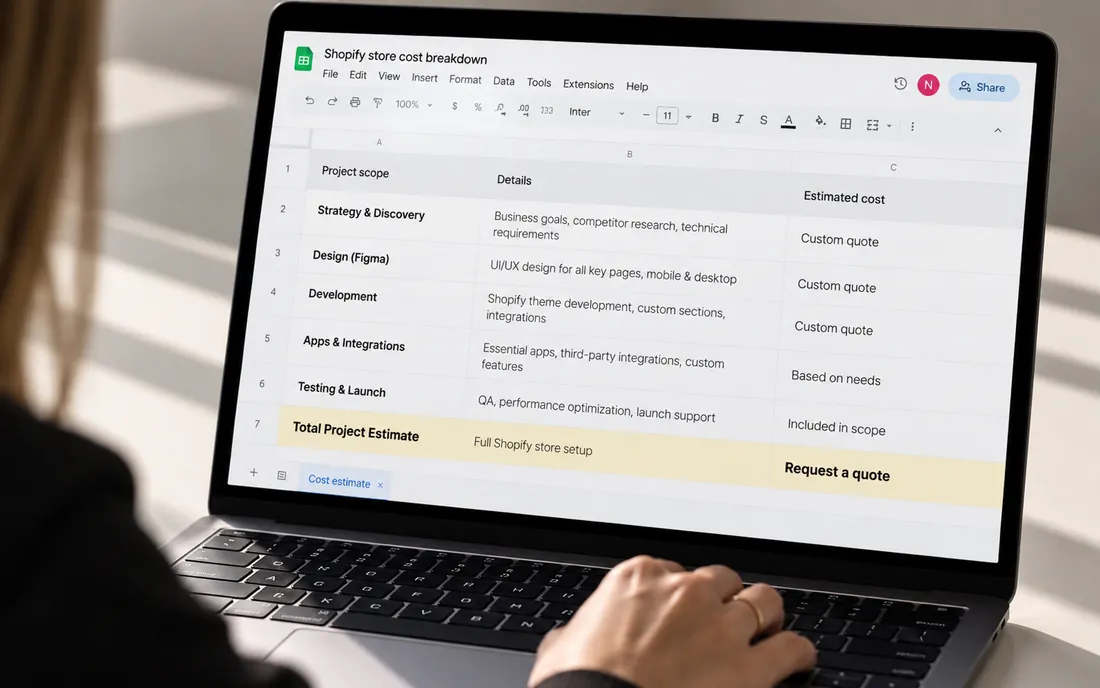
Our take: the hidden cost on WooCommerce is maintenance time. Someone has to update plugins, test for conflicts and fix issues. The hidden cost on Shopify is app subscriptions and transaction fees if you do not use Shopify Payments. Compare both honestly for your volume. Our Shopify cost breakdown covers the Shopify side in detail.
Which is more secure, Shopify or WooCommerce?
Shopify carries most of the security burden for you, while WooCommerce stores depend on how well the site, hosting and plugins are maintained.
Shopify states that it is certified Level 1 PCI DSS compliant. WooCommerce’s documentation says that “PCI DSS compliance is ultimately the responsibility of the store owner,” and that requirements extend to hosting, plugins and update policies (WooCommerce docs).
The WordPress core itself is very secure; the risk sits in plugins. Patchstack recorded 11,334 new vulnerabilities in the WordPress ecosystem in 2025, with 91% in plugins and only 6 in WordPress core (Patchstack). A well-maintained WooCommerce store with few, reputable plugins and good hosting can be secure. A neglected one is a real risk.
Is Shopify or WooCommerce better for SEO?
Both can rank well. WooCommerce gives you more control over URLs and content, while Shopify gives you solid technical defaults with less maintenance.
Shopify generates sitemaps, canonical tags and a managed robots.txt automatically, but its URL structure is fixed (for example /products/ and /collections/), and some duplicate URL patterns need attention. WooCommerce, with a plugin like Yoast or Rank Math, lets you control almost everything, which helps content-heavy brands. See our Shopify SEO guide for the Shopify-specific fixes.
Which scales better?
Shopify scales with less effort, because hosting, traffic spikes and checkout performance are handled by the platform. WooCommerce can scale too, but it needs strong hosting, caching and development as orders grow.
For large catalogs, Shopify supports up to 2,048 variants per product. On WooCommerce, performance with large catalogs depends heavily on hosting and database optimization.
Which is better for B2B and wholesale?
For most brands, Shopify is now the simpler choice for B2B. Since April 2, 2026, native B2B features are included on Basic, Grow and Advanced at no extra cost, per Shopify.
That includes company profiles, up to 3 B2B catalogs, volume pricing and quantity rules, payment terms and vaulted cards. Shopify Plus adds unlimited catalogs, direct catalog assignment, deposits, partial payments and checkout customization. WooCommerce handles B2B through extensions such as B2B for WooCommerce ($149 per year), which offers role-based pricing, quotes and tax exemptions but adds another plugin to maintain. More in our guide to Shopify B2B without Plus.
Which should you choose?
Choose Shopify if you want to focus on selling and marketing rather than running a website. Choose WooCommerce if you already run a content-heavy WordPress site, need full code ownership or have a developer maintaining it.
- Shopify fits: DTC brands, growing teams without in-house developers, B2B and wholesale, international selling, brands that value uptime and simple maintenance.
- WooCommerce fits: content-first businesses, very small catalogs alongside an existing WordPress site, unusual custom requirements and teams with WordPress expertise.
Is it hard to switch from WooCommerce to Shopify?
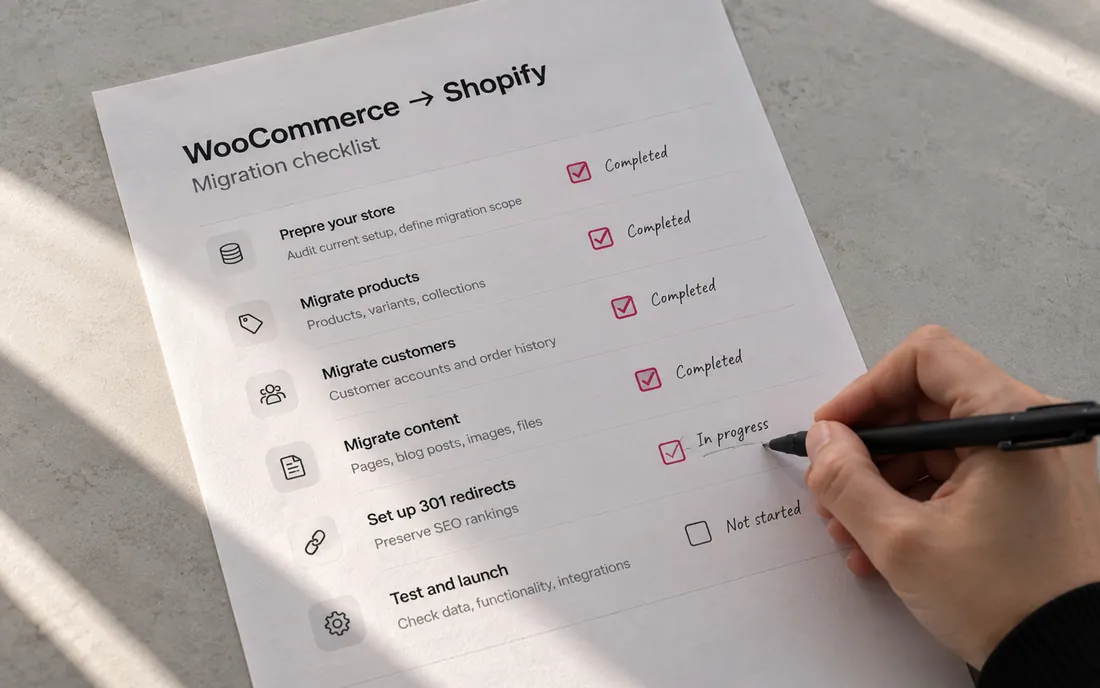
It is a well-trodden path. Products, customers and orders can be moved with import tools or migration apps, and the main work is redirects, design and checking SEO after launch.
- Export and clean your WooCommerce products, customers and orders.
- Map old URLs to new Shopify URLs and plan 301 redirects.
- Rebuild the design as a Shopify theme, either from a premium theme or a custom design.
- Recreate payments, shipping, taxes and email notifications.
- Test orders and redirects, then launch and monitor Google Search Console.
Customer passwords cannot be moved between platforms, so customers typically need to activate or reset their accounts after the switch. Plan an email to let them know.
How we can help
We build Shopify stores and simple WordPress-alternative sites, and we migrate WooCommerce stores to Shopify, keeping products, customers and SEO intact. If you are weighing a move, see our Shopify migration service.
Send us your store URL and we'll email you the fixes that matter most. No call needed.
Frequently asked questions
Is WooCommerce really free?
The WooCommerce plugin is free, but running a store is not. You pay for hosting (typically $25–$350 per month), a domain, payment processing and often paid extensions at $29–$299 per year each, plus maintenance time.
Can I migrate from WooCommerce to Shopify without losing SEO?
Yes, if the migration includes 301 redirects from old URLs, preserved page titles and descriptions, and a check in Google Search Console after launch. Shopify’s URL structure differs from WooCommerce’s, so redirects are essential.
Does Shopify charge more transaction fees than WooCommerce?
Card processing rates are similar on both. The difference is that Shopify adds a 0.6–2% transaction fee if you use a third-party payment provider instead of Shopify Payments, while WooCommerce adds no platform fee for any gateway.
Do I own my store on Shopify?
You own your business data, such as products, customers and orders, and can export them as CSV files. The platform and theme code run on Shopify, so moving away means rebuilding the storefront elsewhere.
Which is easier for beginners?
Shopify is generally easier for beginners because hosting, security, checkout and updates are handled for you. WooCommerce has a steeper learning curve unless you already know WordPress.
Sources
- Shopify Pricing
- WooCommerce Pricing
- WooCommerce docs: PCI-DSS compliance and WooCommerce
- Shopify Security
- Patchstack: State of WordPress Security in 2026
- W3Techs: Usage statistics of WordPress
- Shopify News: B2B for all (April 2, 2026)
- WooCommerce: B2B for WooCommerce extension
- Shopify App Store
- Shopify Changelog: Product variant limit increased to 2,048
- Shopify Help Center: Exporting customers